
How to Identify High Quality Bone Inlay Patterns

Table of Contents
- What Makes Bone Inlay Quality Matter
- Step 1: Examine the Surface Texture and Depth
- Step 2: Assess Material Authenticity and Natural Grain
- Step 3: Inspect the Wood Substrate and Finish Quality
- Step 4: Test Weight and Density
- Understanding Ethical Sourcing of Bone Inlay
- Signs of Mass-Produced Bone Inlay to Avoid
- Is Beeswax Safe for Mother of Pearl Inlay
- Frequently Asked Questions
Last Updated: October 1, 2026
What Makes Bone Inlay Quality Matter
Understanding how to identify high quality bone inlay patterns is essential when investing in handcrafted furniture. The difference between authentic, artisanal bone inlay and mass-produced imitations comes down to specific physical characteristics you can assess yourself. At Mahlia Interiors, we work directly with skilled artisans to create pieces that showcase genuine craftsmanship, and we've learned that educated buyers make the best decisions when they know what to look for.

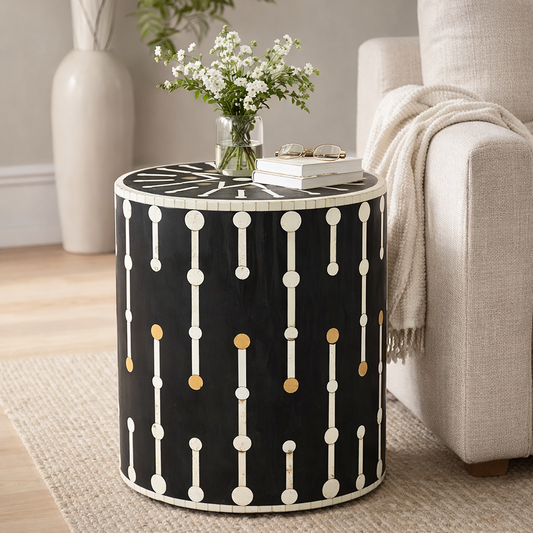
Bone inlay is a decorative technique where pieces of bone (or sometimes mother of pearl) are hand-carved and inlaid into a wood substrate to create intricate patterns. The quality of these pieces varies dramatically based on material authenticity, craftsmanship, and construction methods. When you understand the markers of quality, you'll spot the difference between a genuine handcrafted piece and a printed or mass-produced alternative instantly.
Step 1: Examine the Surface Texture and Depth
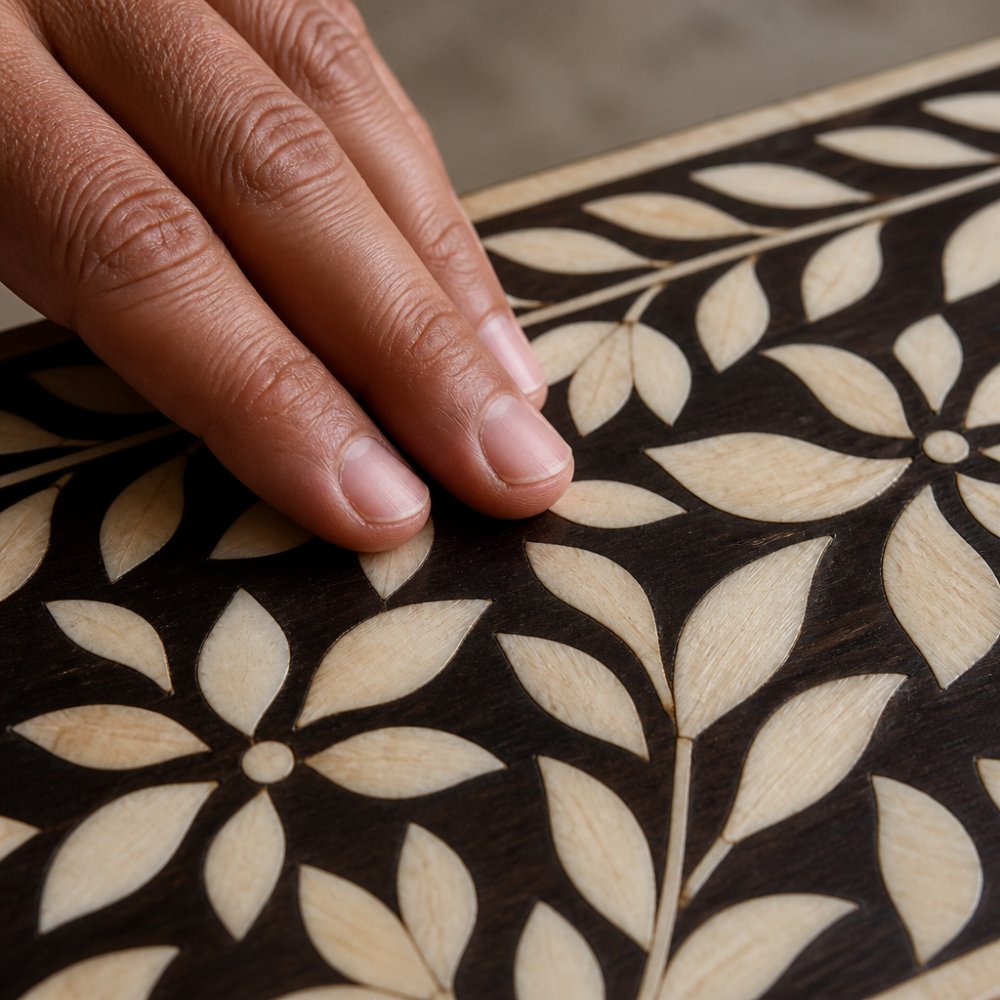
The first test for authenticity happens when you run your fingers across the surface. Real bone inlay has tactile qualities that synthetic alternatives simply cannot replicate.
Run your fingers across the inlay
Touch is your most honest assessment tool. Genuine bone inlay feels slightly raised or recessed depending on how the artisan finished the piece. The surface should feel irregular in a way that suggests human hands shaped it. Mass-produced pieces typically feel uniformly flat and smooth because they're printed or applied as a thin veneer.
Press gently on the bone sections. They should feel solid and substantial. If the surface feels like it might peel or flake under pressure, you're likely looking at a coating rather than true inlay.
Look for inconsistencies and hand-carved marks
Handcrafted bone inlay patterns show visible evidence of the artisan's tools. Look closely at the edges where bone meets wood. You'll see slight variations in depth, small tool marks, and areas where the fit isn't perfectly uniform. These "imperfections" are actually proof of authenticity.
Examine the pattern lines. Do they vary slightly in width? Are there micro-scratches or tool impressions visible under light? These marks indicate a skilled artisan carved each piece individually. Printed patterns appear too uniform, too perfect, and too consistent across the entire surface.
Run your eye across the entire piece from different angles. Genuine bone inlay catches light differently depending on the angle because the surface isn't perfectly flat. Mass-produced alternatives lack this dimensional quality.
Step 2: Assess Material Authenticity and Natural Grain
Real bone and synthetic resin behave completely differently under close examination. Learning to distinguish them protects you from overpaying for imitation materials.
Use magnification to reveal pore structure
Bone's most reliable identifier is its natural porosity, a feature synthetic resin cannot authentically replicate. To see this clearly, you need magnification. A standard 10× jeweller's loupe (available from hardware or craft suppliers for under $20) reveals the difference instantly.
When you examine genuine bone under 10× magnification, you'll see a network of tiny, irregular pores scattered across the surface. These pores are the remnants of the bone's vascular system and appear as dark or shadowed pinpoints. The pore pattern is never uniform; density varies across the surface, creating a natural, organic appearance.
Synthetic resin under the same magnification appears uniformly smooth and featureless. You may see air bubbles (which appear as larger, more regular voids) or a completely glassy, featureless surface. The absence of the fine pore network is the giveaway.
If you don't have a loupe, use your smartphone's macro mode or a macro lens attachment (many are available for under $15). Position your phone 2-3 cm from the inlay surface and zoom in digitally. Take photos of both the bone inlay and any resin or plastic components on the piece for comparison. The pore structure will be unmistakable in the magnified image.
Compare colour variation and aging patterns
Natural bone develops subtle colour shifts because it is an organic material that responds to light, humidity, and time. Examine the inlay under natural daylight, not artificial lighting. You should see variations in tone: cream fading to pale yellow, white transitioning to soft beige, or areas where the bone has aged to a warmer ivory. These variations occur unevenly across a piece because different sections of bone age at different rates depending on exposure and use.
Synthetic resin maintains consistent, uniform colour throughout. If every section of the inlay looks identically coloured, as if painted from a single batch, that's a strong indicator of synthetic material.
For older or vintage pieces, look for patina development. Genuine aged bone develops a subtle darkening or mellowing of colour, particularly in areas that receive regular handling or sunlight. This patina cannot be faked convincingly because it develops unevenly over years and responds to the specific environment where the piece has lived. If a piece claims to be handcrafted and vintage but shows zero patina development or colour variation, question whether it is truly aged or whether the inlay is original to the frame.
Examine grain structure within the bone
Bone has a natural grain structure that mirrors its growth pattern. Under magnification or strong light, you'll see subtle linear patterns running through the bone sections. These lines follow the bone's internal structure and are never perfectly parallel or uniform. They may shift direction slightly or appear denser in some areas than others.
Resin has no grain structure. It appears homogeneous throughout. If you magnify a section and see absolutely no linear pattern or directional grain, you're looking at resin or plastic, not bone.
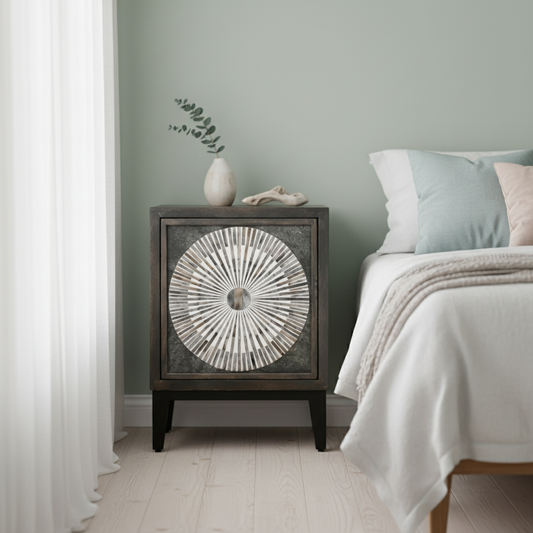
Bone Inlay Large Bedside Table : Art Deco →
Another test: run your fingernail gently across the surface (on an inconspicuous area first). Real bone's grain creates slight resistance or texture variation as your nail crosses the grain direction. Resin feels uniformly smooth in all directions.
Step 3: Inspect the Wood Substrate and Finish Quality
The wood base matters as much as the bone inlay. Poor substrate quality undermines even beautiful inlay work.
Examine the wood finish. Is it smooth and even, or does it show variations in sheen and colour? Handcrafted pieces from skilled artisans display careful finishing work. The wood should feel smooth but not plastic-like. Run your hand across areas without inlay, the wood finish should feel warm and natural, not slick or artificial.
Check the joints and seams. Do drawers fit tightly with minimal gaps? Are corners flush and well-aligned? Poor joinery indicates mass production. Quality furniture shows careful construction details throughout.
Look underneath the piece if possible. The underside reveals whether the artisan finished the entire piece or just the visible surfaces. Genuine handcrafted furniture receives attention everywhere, not just where customers see it.
Inspect the finish for consistency. Does the wood colour match across the entire piece, or are there variations? Handcrafted pieces sometimes show natural wood variation. Uniform colour across large surfaces suggests staining or treatment rather than natural wood aging.
Step 4: Test Weight and Density
A simple weight and density assessment reveals whether you're holding genuine materials or lightweight imitations. Unlike visual inspection, this test requires no tools, only your hands and basic comparison.
Assess overall heft and material substance
Pick up the piece and hold it in both hands. Authentic bone inlay furniture feels substantially heavier than you might expect for its size. The wood base should be solid hardwood (teak, sheesham, or mango wood are common choices), not veneer over particle board or MDF.
Here's a practical reference: a small side table (roughly 45 cm × 45 cm × 50 cm tall) with genuine bone inlay and solid hardwood construction typically weighs 12-18 kg.
Test the thickness and solidity of inlay sections
Geniune bone inlay uses substantial pieces of bone, typically 3-5 mm thick. This thickness is visible at the edges where bone meets wood. Look at the profile of the inlay from the side, you should see clear depth. Thin veneers or printed surfaces appear papery and fragile by comparison.
Perform a temperature touch test
Bone and wood conduct temperature differently than resin or plastic. This simple test requires no equipment.
Understanding Ethical Sourcing of Bone Inlay
Quality extends beyond aesthetics to include ethical considerations. Knowing the sourcing story matters if you value conscious consumption.
Signs of Mass-Produced Bone Inlay to Avoid
Learning what to reject protects your investment. Mass-produced alternatives share common characteristics that reveal their true nature.
Is Beeswax Safe for Mother of Pearl Inlay
Maintaining mother of pearl requires careful product selection. Not all finishes are appropriate for this delicate material.
Frequently Asked Questions
How can you tell if bone inlay is hand-carved versus machine-made?
Hand-carved bone inlay shows subtle irregularities, slight depth variations, and visible tool marks when examined closely. Machine-made pieces have uniform, perfectly consistent patterns with no natural variation. Run your fingers across the surface; authentic hand-carved work feels tactile with minor surface undulations, while mass-produced inlay feels uniformly smooth. Look for evidence of hand-polishing and natural grain variation in the bone itself, which indicates artisanal craftsmanship rather than industrial production.
What should I look for in the resin finish of bone inlay?
Quality resin finish should be smooth, even, and level with the bone pieces, creating a cohesive surface without gaps or raised edges. Examine the finish under light; it should have a subtle sheen rather than a plastic-looking gloss. Check for air bubbles, cracks, or yellowing, which indicate poor-quality resin or improper application. The resin should feel slightly warm to the touch and show no separation from the bone. A well-finished piece will have consistent colour throughout without discolouration or cloudiness.
Why is ethical sourcing of bone inlay important, and how do I verify it?
Ethical sourcing ensures bone comes from sustainable, humane sources and supports artisan communities rather than exploitative practices. Reputable makers provide documentation about material sourcing and can explain their supply chain transparently. Ask suppliers directly about their sourcing practices and whether they work with certified artisan communities. Quality makers like Mahlia Interiors are transparent about using 100% ethically sourced materials and supporting traditional craftsmanship. Avoid sellers who cannot answer questions about where materials originate or how artisans are compensated.
Is beeswax safe for mother of pearl inlay finishes?
Beeswax can be used on bone inlay but requires caution with mother of pearl. While beeswax is a natural, gentle option, it can leave residue on mother of pearl if not applied sparingly and buffed thoroughly. Always test any finish on an inconspicuous area first. When in doubt, gentle cleaning with a slightly damp microfibre cloth followed by dry buffing is the safest approach for mixed-material pieces.