
Signs of Ethically Sourced Bone Inlay: 2026 Guide

Table of Contents
- What Ethically Sourced Bone Inlay Actually Means
-
7 Signs of Ethically Sourced Bone Inlay to Check Before You Buy
- Sign 1: The Seller Explains Where the Bone Came From
- Sign 2: The Bone Is a By-Product, Not a Harvest
- Sign 3: Artisan Cooperatives Are Named, Not Implied
- Sign 4: The Seller Can Show Documentation
- Sign 5: Pricing Reflects Hand-Setting, Not Machine Output
- Sign 6: The Pattern Shows Hand-Cut Irregularity
- Sign 7: The Seller Answers Follow-Up Questions Without Deflecting
- Ethical Furniture Certification Explained: What Documents Prove
- How to Spot Fake Bone Inlay and Synthetic Alternatives
- Resin, Glue and the Environmental Cost of Cheap Inlay
- Bone Inlay Furniture Care Guide for Humid Homes
- Questions Worth Asking Before You Commit
- Conclusion
- Frequently Asked Questions
Last Updated: September 11, 2026
What Ethically Sourced Bone Inlay Actually Means
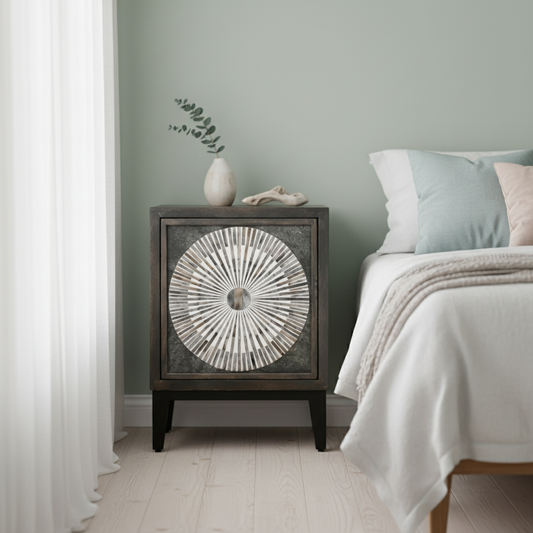
Ethically sourced bone inlay is decorative furniture and homeware made using animal bone that was obtained as a by-product of the food industry, not from animals killed for their skeletons, with artisan makers paid fairly and working conditions that can be documented on request. The bone is hand-cut and set into a timber frame, usually with resin filling the gaps between pieces.

That definition matters because the phrase gets stretched. Some sellers use "ethically sourced" to mean nothing more than "we asked our supplier." Others use it to describe material from domesticated animals, which tells you the species but not how the animal was treated or how the artisan was paid.
This guide breaks down the specific, checkable signs that separate genuine ethical sourcing from marketing language, and the questions that expose a vague answer fast.
Camel Bone, Buffalo Bone and Where the Material Comes From
Camel bone and buffalo bone are the two materials you'll see named most often in inlay work. Both come from domesticated animals raised for milk, meat or labour, and in a genuine supply chain the bone is collected after the animal has been processed for those purposes. The bone is then cleaned, dried, cut into thin shapes and set by hand into a timber base.
What most guides miss is that species alone proves nothing. A buffalo bone inlay piece can still come from a supply chain with no traceability at all. The species is the starting point of the question, not the answer.
7 Signs of Ethically Sourced Bone Inlay to Check Before You Buy
The fastest way to judge a seller is to ask one direct question and listen to how specific the answer is. Vague, warm-sounding replies are the single biggest red flag. Here are the seven signs worth checking, in the order they tend to reveal the most.
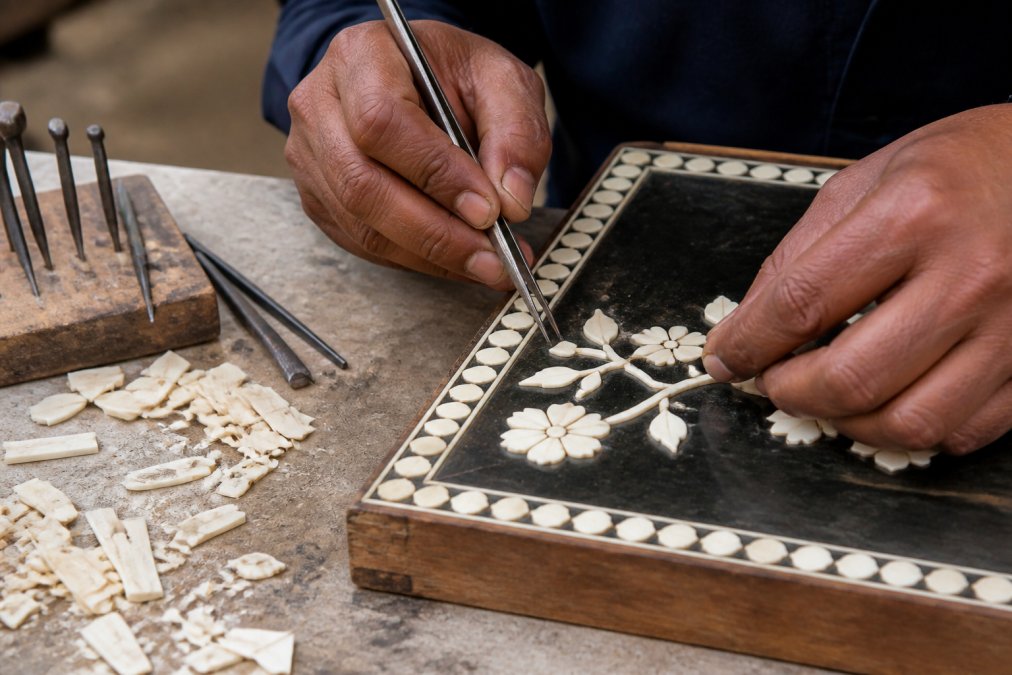
Sign 1: The Seller Explains Where the Bone Came From
A seller who genuinely knows their supply chain names the region and the type of supplier, not just the country. "Our bone comes from food-industry by-products collected in Rajasthan" is a real answer. "Sustainably sourced" on its own is not.
Sign 2: The Bone Is a By-Product, Not a Harvest
Ask directly whether any animal is killed for its bone. In an ethical supply chain the answer is no, and the seller should be able to explain that the bone is a by-product of animals raised for other purposes. If the answer dodges the question, treat that as your answer.
Sign 3: Artisan Cooperatives Are Named, Not Implied
The strongest sellers name the artisan cooperatives or workshops they work with. Naming a group is a commitment: it can be checked, and it signals the seller has an actual relationship rather than a purchasing agent.
Sign 4: The Seller Can Show Documentation
Ask what paperwork exists. A traceability document, a supplier declaration, or a certificate from a recognised body all count. If nothing exists in writing, the claim rests entirely on trust.
Sign 5: Pricing Reflects Hand-Setting, Not Machine Output
Genuine hand-setting is slow. A piece where every bone fragment is individually shaped and placed takes far longer to produce than a printed or moulded imitation, and the price reflects that labour. Suspiciously cheap "bone inlay" is usually resin with a printed pattern.
Sign 6: The Pattern Shows Hand-Cut Irregularity
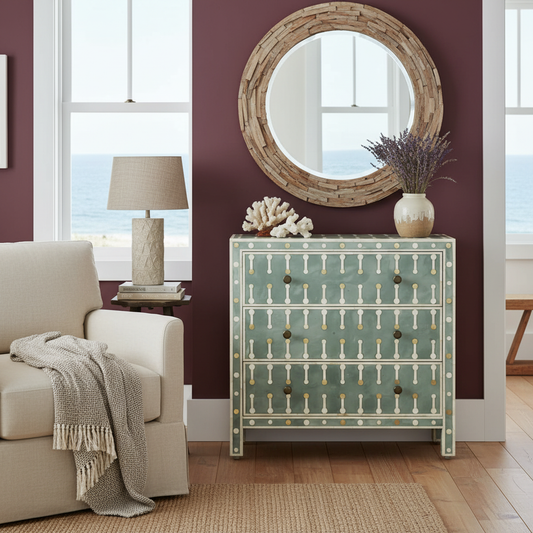
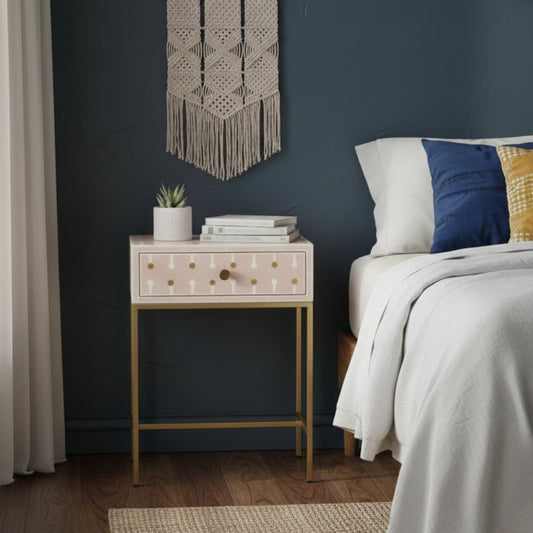
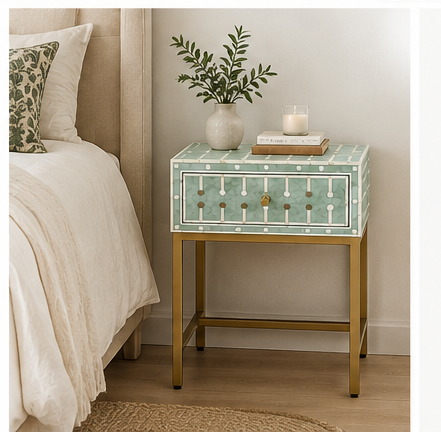
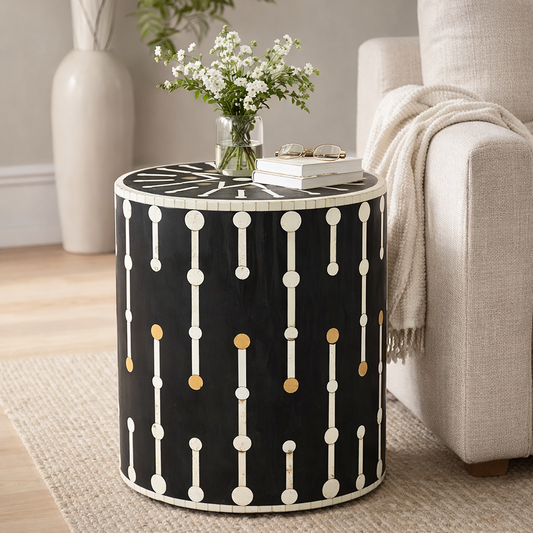
Look closely at the bone pieces. Hand-cut fragments vary slightly in size and shape, and the lines between them are never perfectly uniform. Machine-cut or printed patterns repeat with mechanical precision.
Sign 7: The Seller Answers Follow-Up Questions Without Deflecting
Send two or three follow-up questions. A seller with a real supply chain answers them. A seller repeating marketing copy starts circling.
Ethical Furniture Certification Explained: What Documents Prove
Ethical furniture certification is third-party or supplier-issued documentation that verifies a specific claim about how a piece was made, such as material origin, fair labour, or sustainable timber. There is no single universal certificate that covers "ethical" in full. Different documents prove different things, and the honest position is that most handcrafted inlay from small workshops will not carry a formal international certificate at all.
That does not automatically make a piece unethical. What it means is that documentation and direct answers from the seller carry more weight, and you should expect a credible seller to be transparent about what they can and cannot prove. Here is what each type of document actually demonstrates, and how to read it.
| Document type | What it proves | What it does not prove | What to ask for |
|---|---|---|---|
| Supplier declaration | The supplier states the bone is a food-industry by-product | Independent verification of that claim | A signed, dated declaration naming the supplier and region |
| Traceability record | Material origin and chain of custody | Fair pay or working conditions | A document that names each hand-off from collection to workshop |
| Artisan cooperative agreement | A named relationship with a maker group | Environmental impact of materials used | The cooperative's name and a contact you can verify independently |
| Timber certification | Wood is from a responsibly managed source | Anything about the bone or resin | A chain-of-custody number, not just a logo |
| Low-VOC resin data sheet | The resin system used and its emission profile | That the resin was applied safely | The manufacturer's technical data sheet, not a marketing claim |
Public Frameworks Worth Knowing
A few public frameworks come up often enough in this category that buyers should recognise the names:
- CITES (the Convention on International Trade in Endangered Species) governs trade in protected species. Domesticated camel and buffalo bone is not a CITES-listed material, so a CITES permit is not the right document to ask for on an inlay piece, but a seller who claims CITES certification for buffalo bone is either confused or hoping you are (cites.org).
- FSC (Forest Stewardship Council) certification applies to the timber frame, not the bone. If a seller cites FSC, ask which component it covers.
- Fair-trade and artisan-cooperative schemes vary widely. Some are rigorous third-party audited programmes; others are self-declared membership badges. Ask which one, and whether it is independently audited.
How to Read a Document You Are Sent
A document is only useful if it is specific. When a seller sends you paperwork, check four things:
- Does it name a party? A declaration with no supplier name is not traceable.
- Does it name a place? Region and country, not just "overseas".
- Is it dated? An undated declaration could be years old.
- Does it match the piece? A timber certificate for a different species or a different workshop is not evidence for the item in front of you.
CITES official species database
Forest Stewardship Council certification lookup
How to Spot Fake Bone Inlay and Synthetic Alternatives
Fake bone inlay is furniture that mimics the look of hand-set bone using resin, printed vinyl, or moulded plastic inserts, often sold under the same descriptions as genuine pieces. The giveaway is almost always in the surface itself.

Visual Identification Guide: Bone, Resin and Printed Imitations
Genuine bone has a subtle natural grain, slight colour variation between pieces, and tiny pores you can see under angled light. Resin imitations are uniformly smooth and often too consistent in colour. Printed patterns repeat identically across the surface with no depth, and if you run a fingernail lightly across the pattern you feel a flat surface rather than the slight ridges of set bone. On a genuine piece, the resin fills the gaps between bone fragments; on a fake, the "bone" is printed onto the resin.
Resin, Glue and the Environmental Cost of Cheap Inlay
The bone and timber get all the attention, but the resin and adhesive are where cheap production hides its real cost. Lower-cost pieces often use solvent-heavy resins and glues with higher volatile organic compound content, which affects indoor air quality and makes the piece harder to repair later. Better makers use lower-emission resin systems and are willing to say which one they use.
Ask what resin is used and whether it's low-VOC. A seller who can answer that is almost certainly a seller who knows their workshop.
Bone Inlay Furniture Care Guide for Humid Homes
Humidity is the main long-term threat to inlay furniture. Timber expands and contracts with moisture, and if the frame moves more than the set bone can tolerate, you get hairline cracks along the pattern. The mechanism is simple: bone and resin are relatively dimensionally stable, but the timber substrate is not. When the frame swells in a wet season and shrinks in a dry one, the bond between bone and resin is stressed at every fragment edge. Over several cycles, that stress shows up as cracking, lifting, or a faint shadow line around individual pieces.
In a humid climate, keep pieces away from open windows, air conditioning vents, bathrooms, and any wall that stays cold and damp. A steady indoor humidity range is more important than a low one, a piece that sits at 55% year-round fares better than one that swings between 40% and 80%.
Routine Care That Actually Protects the Piece
- Dust with a soft, dry, lint-free cloth. Do not use a damp cloth on the bone or resin.
- Wipe spills immediately rather than letting liquid sit in the resin gaps, where it can wick under the bone and stain the timber.
- Apply a quality furniture wax once or twice a year. A thin coat seals the surface without building up residue in the pattern.
- Never use abrasive cleaners, alcohol-based products, or ammonia. These dull the resin and can lift the bone.
- Keep pieces out of direct sun. UV degrades resin over time and can yellow pale bone.
What to Do If You See a Hairline Crack
A hairline crack along the pattern is usually a moisture-movement issue, not a manufacturing fault. Do not fill it with household glue. A small amount of furniture wax worked into the crack can stabilise it cosmetically while you address the humidity. If the crack widens, or if a bone fragment lifts, contact the maker, a repair by someone who understands the resin system is far less likely to cause further damage than a general furniture restorer.
Questions Worth Asking Before You Commit
A short, specific list beats a long one. Ask these five before you buy:
- Where was the bone collected, and can you confirm it's a food-industry by-product?
- Which artisan cooperative or workshop made this piece?
- What documentation can you send me?
- What resin and adhesive are used, and are they low-VOC?
- What's your lead time and what happens if the piece arrives damaged?
If a seller answers all five without hesitation, you're dealing with someone who knows their supply chain. If they answer two and deflect on three, you have your answer.
Conclusion
Buying inlay furniture well comes down to asking better questions than most sellers expect, and being willing to walk away from vague answers. The pieces that hold their value are the ones where the maker can name the workshop, explain the material, and stand behind the work years later.
At Mahlia Interiors, every piece is individually handcrafted using 100% ethically sourced materials, made in collaboration with artisan communities, and available as custom inlay designs tailored to your space. Our Bone Inlay Rectangular Tray in Starburst Yellow (45cm x 30cm x 5cm, $260) and our Bone Inlay Coasters in Charcoal Starburst ($99 for a set of four) are an easy way to see the hand-setting quality up close before committing to a larger piece.

Get started with Mahlia Interiors and bring a piece into your home that reflects unique style and ethical craftsmanship.
Frequently Asked Questions
Is bone inlay furniture ethical?
It can be, provided the bone comes from domesticated animals such as camels or buffalo that died naturally or were processed for meat, and the material is treated as a by-product rather than the reason for slaughter. Ethically sourced bone inlay also means the artisans who carve and set each piece are paid fairly and work in safe conditions. Ask the seller to explain their supply chain in plain terms. If they cannot name where the bone came from or who made the piece, treat that as a warning sign.
How can you tell if bone inlay is genuine?
Genuine bone inlay has small, irregular pieces set by hand, so no two sections are identical. Look closely at the surface: real bone shows faint grain, tiny pores and slight colour variation between pieces, while resin imitations are uniformly smooth and perfectly even. Run a fingernail lightly across an edge. Bone feels cool and dense, resin feels warmer and lighter. On a genuine piece, the pattern continues around corners and joins cleanly, because each fragment was cut and set individually rather than printed or moulded.
What certifications should I look for in artisan-made furniture?
There is no single mandatory certification for bone inlay in Australia, so documentation matters more than logos. Ask for written material provenance, the name and location of the artisan workshop or cooperative, and any fair trade or export paperwork the supplier holds. Reputable sellers will share this without hesitation. A useful test is whether the paperwork names a specific workshop rather than a vague region. Combine that with a maker who can describe their inlay technique and finishing process, and you have far stronger evidence than a badge alone.
How do I care for bone inlay in a humid climate?
Keep pieces out of direct sun and away from air conditioning vents, and wipe with a soft dry cloth rather than a wet one. In humid conditions, avoid leaving water rings or spills on the surface, since moisture can lift the resin and shift set bone over time. Use coasters under drinks and keep trays and boxes away from open windows during wet weather. A light coat of quality furniture wax every few months helps seal the surface. Small cracks or loose fragments should be repaired promptly by a restorer rather than glued at home.