
5 Turning Points in Inlay Furniture Craftsmanship

Last Updated: October 24, 2026
Quick Summary
Inlay furniture craftsmanship is a centuries-old decorative tradition where artisans embed contrasting materials like bone or mother-of-pearl into recesses in solid wood, creating flush surfaces with precise patterns. The technique emerged in ancient Egypt, flourished during the Islamic Golden Age in Persia, and developed distinctive regional expressions across India, Europe, and beyond through cross-cultural trade and court patronage.
- Inlay work appeared earliest in ancient Egypt and was refined by Persian artisans during the Islamic Golden Age.
- Hand-cutting and fitting individual pieces requires 200-300 hours for intricate work and cannot be mechanised without compromising quality.
- Bone inlay produces warm ivory tones while mother-of-pearl creates luminous, colour-shifting surfaces with different durability properties.
- Maintaining stable humidity between 45-55 percent and avoiding direct sunlight preserves inlay furniture across decades.
- Each handcrafted piece carries natural variations in colour and pattern, which are hallmarks of authenticity rather than defects.
Table of Contents
- Where Inlay Furniture Craftsmanship Began
- How Inlay Furniture Is Made: From Design to Finished Piece
- Traditional Inlay Techniques Across Cultures
- Bone Inlay vs Mother-of-Pearl Inlay: Understanding the Difference
- Materials That Define Inlay Craftsmanship
- Caring for Inlay Furniture to Preserve Its Beauty
- Investing in a Handcrafted Inlay Piece for Your Home
- Frequently Asked Questions
Where Inlay Furniture Craftsmanship Began
Inlay furniture craftsmanship spans centuries and continents, one of furniture design's most refined decorative traditions. It emerged as a way for artisans to transform solid wood into storytelling surfaces, embedding contrasting materials into patterns of extraordinary precision.
The earliest documented inlay work appeared in ancient Egypt, where craftspeople embedded precious materials into furniture for royalty.
UNESCO's documentation of traditional craftsmanship recognises inlay work as a heritage craft requiring extraordinary skill and cultural knowledge.
A chronological framework for understanding inlay history
Separating established chronology from popular origin stories helps clarify the history. This timeline draws on museum collections, dated examples, and specialist literature.
| Period | Region | Development | Evidence and caveats |
|---|---|---|---|
| c. 3000-1000 BCE | Egypt | Early inlay of ivory, ebony, and precious metals into wooden furniture for elite tombs | Furniture fragments from tomb contexts; attribution relies on archaeological records rather than continuous craft lineage |
| c. 700-1200 CE | Persia and the Islamic world | Refinement of geometric inlay, tool techniques, and pattern vocabularies | Surviving architectural and furniture elements; many techniques documented in later treatises rather than contemporaneous manuals |
| c. 1200-1500 CE | Italy and Iberia | Development of marquetry and intarsia as distinct disciplines | Dated church and court furniture; terminology varies by region and period |
| c. 1500-1700 CE | Indian subcontinent | Mughal courts commission elaborate inlaid pieces; Persian geometric discipline blends with local floral sensibilities | Court records and surviving palace furniture; regional attribution often debated among specialists |
| c. 1700-1900 CE | Europe and India | Inlay and marquetry diverge into separate workshop traditions; colonial trade spreads materials and patterns | Export records and museum catalogues; provenance gaps are common |
| c. 1900-present | Global | Revival of handcraft, ethical sourcing debates, and conservation science | Contemporary craft documentation and conservation literature |
Many popular origin stories, such as a single-point invention of bone inlay in one city, are not supported by dated evidence. Specialist literature treats inlay as a family of related techniques that developed independently in several regions, with cross-cultural influence accelerating after the medieval period.
Distinguishing inlay, marquetry, intarsia, and veneer
Four related terms are often used interchangeably, but they are not the same:
- Inlay involves cutting a recess into a solid substrate and setting contrasting pieces into that recess so the surface remains flush. The substrate is structural.
- Marquetry involves assembling thin veneers into a pattern, often on a separate sheet, and then applying that sheet to a substrate. The decorative layer is thin and the substrate is usually secondary.
- Intarsia is a related Italian tradition of embedding wood pieces into a solid ground, often with pictorial or architectural scenes. It overlaps with inlay but has its own historical lineage and terminology.
- Veneer is a thin layer of quality wood applied to a cheaper substrate for appearance or stability. Veneer may be plain or used as the base for marquetry, but it is not inlay by itself.
These distinctions matter for collectors and conservators: they determine how a piece was constructed, how it should be repaired, and what tradition it belongs to. A bone-inlaid buffet and a marquetry cabinet may look equally decorative, but their construction and conservation needs differ.
Cross-cultural influences and regional developments
The strongest evidence for cross-cultural influence comes from trade routes and court patronage rather than a single diffusion point. Persian geometric vocabularies travelled with craftspeople and pattern books into the Indian subcontinent, where local artisans adapted them to available materials and floral traditions.
What unites these traditions is the fundamental methodology, cutting, fitting, and setting contrasting materials into a wooden base, but the visual language varies by region and period. Understanding this chronology helps collectors appreciate why certain pieces carry cultural significance, and why claims about a single origin warrant caution.
How Inlay Furniture Is Made: From Design to Finished Piece
Creating inlay furniture craftsmanship is a meticulous process that cannot be rushed or mechanised. It begins with design: artisans sketch geometric or floral patterns, study the wood grain, consider how light will interact with the inlay materials, and plan the composition for visual balance.
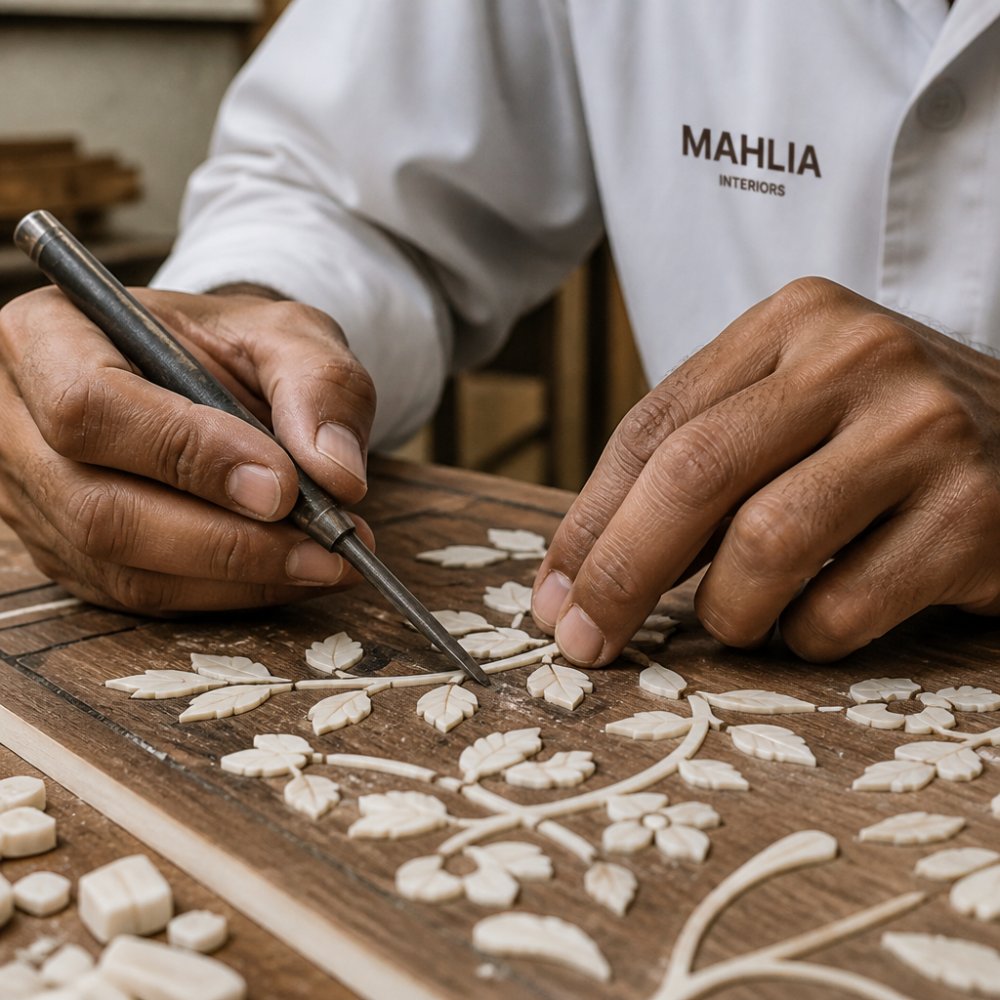
The woodworker then selects premium timber, typically rosewood or another dense hardwood, and prepares the base surface.
Hand-cutting and fitting individual pieces
The heart of inlay furniture craftsmanship lies in hand-cutting individual pieces of bone, mother-of-pearl, or other inlay materials.
A common mistake is assuming this step is simply repetitive labour. In reality, every piece requires individual assessment.
Cutting typically takes weeks per piece, depending on pattern complexity; for a buffet with intricate motifs, an experienced artisan might spend 200-300 hours on cutting and fitting alone.
Setting inlay into the surface
Once cut and fitted, pieces are set into the wooden surface using traditional adhesives. The artisan applies a binding agent, historically natural resins, now often high-quality epoxy, into the prepared recesses and positions each piece.
This stage requires absolute precision: any piece that shifts during drying creates visible gaps or misalignment, so the artisan monitors the work constantly as the adhesive cures.
Traditional Inlay Techniques Across Cultures
Inlay furniture craftsmanship developed distinctly different expressions depending on cultural context and available materials, united by the fundamental methodology of cutting, fitting, and setting contrasting materials into a wooden base.
Geometric and floral patterns
Geometric patterns dominate Persian and Islamic inlay traditions, reflecting the mathematical precision valued in Islamic art, stars, hexagons, and interlocking designs that create optical movement.
The choice between geometric and floral patterns is not merely aesthetic; it reflects different cultural philosophies. Geometric patterns emphasise order, symmetry, and mathematical harmony, while floral patterns celebrate naturalism and organic complexity, which helps explain why certain pieces resonate with different interior aesthetics today.
Regional variations and Persian influence
Persian artisans established many of the technical standards that influenced inlay work across the Islamic world. Their emphasis on precision, tool techniques, and geometric vocabulary became foundational. When Persian influence entered India through trade and the Mughal courts, local craftspeople adapted these methodologies while introducing their own floral sensibilities and material preferences.
Rajasthan became the primary centre for Indian inlay furniture craftsmanship, blending Persian geometric discipline with Indian decorative traditions, while Udaipur emerged as a hub for particularly refined bone inlay work.
Bone Inlay vs Mother-of-Pearl Inlay: Understanding the Difference
Bone inlay and mother-of-pearl inlay are sophisticated expressions of the same fundamental craft, yet they create distinctly different outcomes.
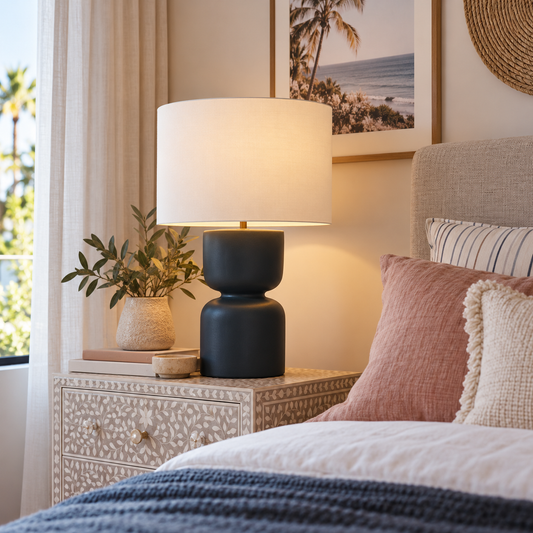
Bone Inlay Dining Table : Kelly Wearstler International Design →
Material choice affects appearance, durability, and care. For how to spot high-quality mother of pearl inlay, understanding these properties is essential to evaluating craftsmanship and longevity.
Bone inlay creates matte, sophisticated surfaces ideal for understated contemporary interiors; mother-of-pearl produces dramatic visual impact, making it a natural choice for statement pieces.
Materials That Define Inlay Craftsmanship
Materials fundamentally shape a piece's character, durability, and cultural authenticity. Rosewood remains the gold standard for the wooden base, prized for its density, rich colour, and ability to accept precise inlay work without splintering.
Bone, traditionally from camel, cow, or buffalo, offers warmth and accepts natural dyes; contemporary ethical sourcing means it comes primarily from animals raised for food. Mother-of-pearl, harvested from oyster shells, provides the characteristic luminous quality.
Artisans choose materials based on how they'll perform in the piece's climate, how they'll age over decades, and how they align with the design's cultural authenticity. This is why how bone inlay furniture is made step by step requires understanding material properties as thoroughly as cutting techniques.
Sourcing, animal welfare, and regulatory context
Bone inlay raises legitimate questions about animal welfare and sourcing. Most contemporary bone comes from animals raised for food, and reputable workshops can often trace their supply chain to food-processing by-products.
In Australia, the import and trade of wildlife products, including some shell and bone materials, is regulated under the Environment Protection and Biodiversity Conservation Act 1999 and administered by the Department of Climate Change, Energy, the Environment and Water.
Alternatives include responsibly harvested shell, synthetic resin composites, and reconstituted materials.
How material choice affects conservation and longevity
Material choice determines how a piece ages and what conservation treatment it may need.
Rosewood and other dense hardwoods are preferred because they move less with humidity changes, reducing the risk of gaps around inlay.
For long-term care, the practical implications are straightforward: keep relative humidity stable, most practitioners find a range of 45-55 per cent suitable, and avoid direct sunlight, which can fade dyes and degrade some shell materials.
Understanding these properties is essential whether you are evaluating a piece, planning its placement, or commissioning a custom work.
Caring for Inlay Furniture to Preserve Its Beauty
Inlay furniture craftsmanship represents an investment in artistry and sustainability, so proper care is essential to preserve its beauty across decades.
Maintenance begins with regular dusting using a soft, dry cloth, avoiding abrasives or harsh chemicals that can damage the inlay surface or wood finish. For how to clean and maintain bone inlay decor, the approach differs slightly by material, but gentle, dry cleaning is always safest.
Protect inlay furniture from direct sunlight, which fades both wood and inlay materials.
Professional restoration should be undertaken only by artisans experienced with inlay work; attempting repairs without proper knowledge can cause irreversible damage. A light re-waxing every few years helps protect the surface and maintain lustre.
Investing in a Handcrafted Inlay Piece for Your Home
Investing in inlay furniture craftsmanship is fundamentally different from purchasing mass-produced furniture.
When evaluating inlay pieces, look for consistent pattern alignment, smooth surfaces with no visible gaps, and evidence of hand-finishing rather than mechanical uniformity.
Our bone inlay furniture collection represents years of collaboration with master craftspeople, ensuring every piece meets exacting standards for design, construction, and material ethics.
This investment supports not just a beautiful object for your home, but the continuation of centuries-old craft traditions and the livelihoods of artisan communities who have perfected this art form across generations.
Frequently Asked Questions
What exactly is inlay furniture craftsmanship?
Inlay furniture craftsmanship is a decorative technique where artisans hand-cut pieces of bone, mother-of-pearl, wood, or other materials and fit them precisely into recessed surfaces on furniture. Unlike carving or painting, inlay creates a seamless, three-dimensional pattern by setting materials directly into the wood. This ancient craft has been refined across cultures for centuries, creating timeless pieces that combine artistry with function.
How has inlay furniture craftsmanship evolved over time?
Inlay furniture craftsmanship originated in ancient Egypt and Mesopotamia, evolved through Persian and Islamic traditions, and reached peak refinement during the Middle Ages and Renaissance. Regional traditions developed in India, particularly in Rajasthan, where artisans created distinctive styles influenced by Mughal design. Modern inlay craftsmanship preserves these historical techniques while adapting to contemporary aesthetics, blending traditional hand-cutting methods with contemporary design sensibilities.
What materials are traditionally used in inlay furniture?
Traditional inlay materials include bone, mother-of-pearl, wood veneers, semi-precious stones, and resins. Bone inlay offers durability and a warm aesthetic, while mother-of-pearl creates luminous, iridescent effects. Rosewood and other hardwoods provide the base structure. Ethical sourcing has become increasingly important, with artisans now prioritising sustainably harvested timber and responsibly sourced bone and shell materials to support both craftsmanship and environmental stewardship.
How should you care for bone or mother-of-pearl inlay furniture?
Care for inlay furniture by wiping gently with a soft, dry cloth and avoiding abrasive cleaners. Use coasters and placemats to protect surfaces from moisture and heat. Keep pieces away from direct sunlight to preserve colour depth and prevent fading. Clean spills promptly with a dry cloth. Avoid excessive humidity and temperature fluctuations, which can cause the base wood to expand or contract. With proper care, handcrafted inlay furniture remains beautiful and functional for generations.
Inlay furniture craftsmanship represents more than decoration, it's a bridge between ancient traditions and contemporary living. By choosing handcrafted inlay pieces, you're investing in timeless beauty, ethical artisanship, and furniture that will age gracefully in your home. Explore our collection of individually handcrafted bone and mother-of-pearl inlay pieces, each designed to bring sophistication and meaning to your living space.