
How to Identify Authentic Bone Inlay

Table of Contents
- Signs of Real Bone Inlay
- Bone Inlay vs Resin Inlay: Key Differences
- Visual Inspection Techniques
- Craftsmanship and Hand-Cutting Techniques
- Ethical Bone Inlay Sourcing: What to Look For
- How to Care for Bone Inlay Furniture
- Non-Destructive Testing Methods
- Frequently Asked Questions
Last Updated: September 19, 2026
Signs of Real Bone Inlay
Learning to identify authentic bone inlay requires understanding the distinctive characteristics that separate it from imitations like resin, plastic, or synthetic materials. Start by observing how the material feels and looks under different lighting.

Handcrafted bone inlay creates natural variations that mass-produced fakes cannot replicate. When you run your hand across authentic bone, you'll feel subtle texture differences, the surface isn't uniformly smooth.
Natural grain lines and irregularities
Real bone displays natural grain patterns, pores, and colour variations, proof of authenticity. Look closely and you'll see fine lines running through the bone, similar to wood grain. Fake bone made from resin or plastic tends to have uniform colour and lacks these natural striations.
Authentic bone inlay shows slight thickness variations where artisans hand-cut each piece, some fragments sit slightly proud of the surface, others fractionally lower. This is the signature of hand-setting techniques passed down through generations.
Texture and the touch test
Authentic bone feels cool to the touch, even in warm rooms, due to its natural density. Resin and plastic warm up faster and feel slightly greasy or waxy.
Real bone has a matte finish with slight texture, almost like fine sandpaper. Resin inlay feels smoother and shinier, with a plastic-like quality.
Press gently on a bone fragment. Real bone has a subtle give when pressure is applied, then springs back slightly. Plastic imitations feel more rigid.
Bone Inlay vs Resin Inlay: Key Differences
Understanding the distinction between bone inlay and resin inlay helps you spot fakes immediately and protects your investment.
Material composition and surface finish
Authentic bone inlay combines bone fragments with a resin backing. Resin inlay uses synthetic materials where bone should be, plastic, acrylic, or low-grade resin shaped to look like bone. These materials lack the complexity of real bone and look flat, uniform, and artificially perfect.
Real bone inlay has a matte, organic appearance where light absorbs and reflects depending on grain direction. Resin inlay has a glossy, plastic-like finish that catches light uniformly.
Weight and durability indicators
Real bone inlay feels substantial and well-balanced. Bone is denser than most plastics, so authentic pieces have noticeable weight. A piece that feels unusually light should raise questions.
Authentic bone inlay pieces withstand decades of use when cared for properly. Plastic imitations can crack, yellow, or become brittle over time, especially in direct sunlight or humid environments.
Visual Inspection Techniques
Proper inspection requires good lighting and patience. These techniques work whether you're examining a piece in person or evaluating photos from an online retailer.
Macro-photography comparison
Ask the seller for close-up photos to help you identify authentic bone inlay surface details. Real bone shows pores, grain lines, and colour variation at magnification. Plastic or resin imitations appear more uniform and featureless. When examining in person, use your phone's macro camera or a magnifying glass to photograph the surface from different angles.
Look for these specific details:
- Fine pores visible in the bone surface
- Grain lines that run in different directions across fragments
- Slight colour gradation within individual pieces
- Irregular edges where bone meets resin
Checking for glue residue and joinery
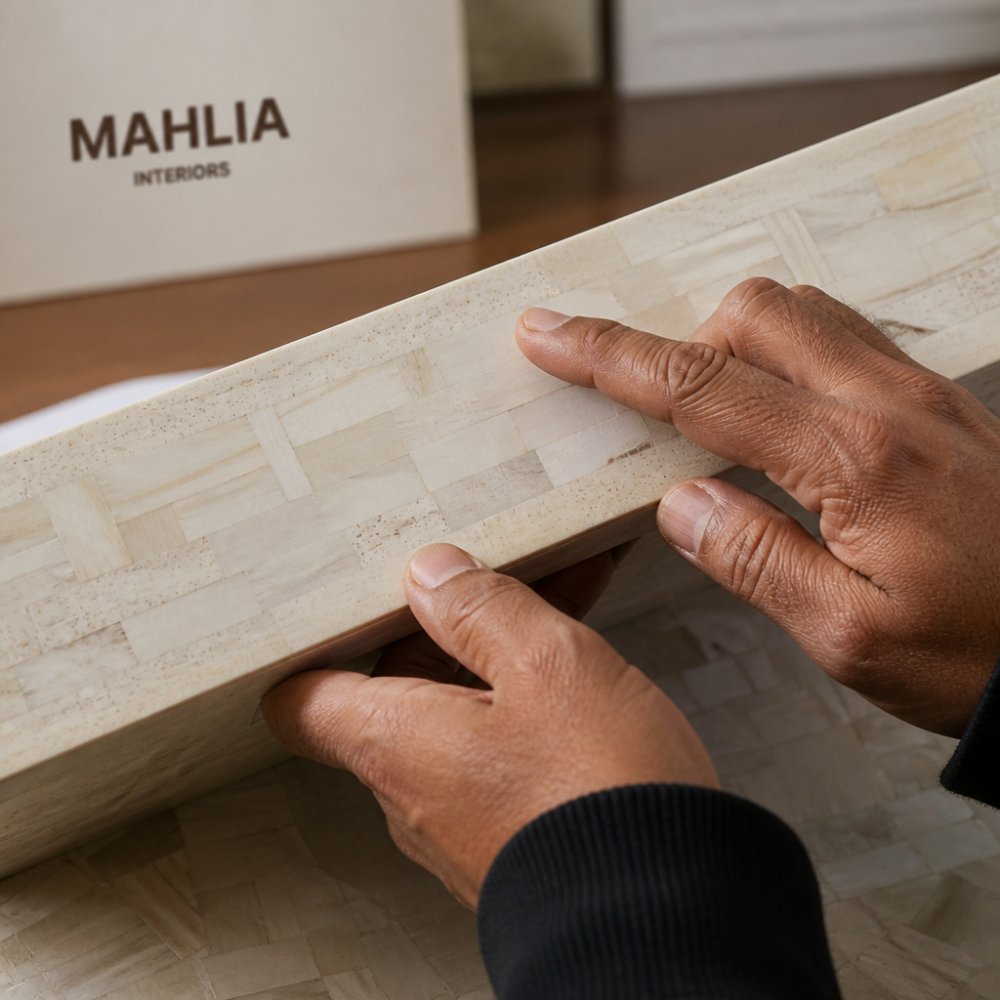
Examine the underside and edges for clean joinery with minimal glue residue. Signs of poor craftsmanship include visible glue lines, excess resin on the surface, uneven gaps, and loose or shifting fragments.
Craftsmanship and Hand-Cutting Techniques
Hand-cutting creates natural variation that machines cannot replicate. Each bone fragment is cut individually using hand tools, not stamped from templates. The slight differences in size, shape, and positioning prove the work is handmade.
Real hand-cut pieces have irregular edges that interlock like a puzzle. Machine-cut pieces align too perfectly, with uniform gaps and symmetrical spacing. Artisans position each fragment individually, creating subtle variations in depth. Mass-produced pieces have fragments set at uniform depth, creating a flat, lifeless appearance.
Bone Inlay 3 Drawer Chest : Medallion →
Ethical Bone Inlay Sourcing: What to Look For
When you invest in bone inlay, you're supporting artisan communities. Ask the seller directly about sourcing. Reputable retailers provide transparency about where materials come from and how artisans are compensated.
Look for these indicators of ethical sourcing:
- Clear documentation of material origin
- Commitment to fair wages for artisans
- Sustainable practices that don't exploit resources
- Transparency about the production process
- Support for artisan communities and traditional techniques
How to Care for Bone Inlay Furniture
Proper care extends the life of your bone inlay pieces significantly. Clean regularly with a soft, dry cloth to prevent dust buildup. Avoid harsh chemicals or abrasive cloths.
Keep the piece away from direct sunlight to prevent yellowing. Manage humidity carefully, extreme moisture can cause wood to swell or warp, while very dry air can cause shrinkage and gaps in the joinery.
Avoid placing wet glasses or hot items directly on the surface. Use coasters and trivets consistently.
Non-Destructive Testing Methods
Several non-destructive tests help confirm authenticity. These methods work best in combination; no single test is foolproof, but together they build a reliable picture of material composition.
The weight and density test
Real bone is significantly denser than plastic or resin. A piece that feels unusually light for its footprint likely contains synthetic materials.
The temperature retention test
The light reflection test
The sound test
Identifying restored or repaired authentic bone inlay
Signs of restoration or repair include:
- Mismatched fragments: If some bone pieces look significantly newer or have different colour, texture, or patina than others, the piece has likely been repaired. Authentic, aged bone develops a consistent patina over decades. Replacement fragments stand out visually.
- Inconsistent grain patterns: Examine the grain lines across all fragments. If some show deep, organic grain and others appear smooth or featureless, the smooth ones may be synthetic replacements inserted during restoration.
- Gaps or uneven seams: Run your fingernail along the edges where bone meets the wooden frame and where fragments meet each other. Quality restoration leaves minimal gaps, but amateur repairs often show visible seams, uneven spacing, or areas where the resin base is exposed.
- Discolouration around fragments: If the resin base around certain fragments is darker, yellowed, or stained differently than elsewhere, those fragments may have been removed and replaced. The resin oxidises and discolours over time; fresh resin looks noticeably different.
- Loose or shifting fragments: Gently press on bone pieces (very gently, don't force). Authentic, well-set pieces are solid. If fragments move, click, or shift, the adhesive has failed and the piece needs professional restoration.
- Uneven surface depth: Run your hand across the surface slowly. Authentic hand-set bone inlay has subtle, natural variations in depth. If you feel sudden drops or rises where fragments meet, or if some areas are noticeably proud of the surface while others are recessed, the piece has been repaired unevenly.
| Testing Method | What to Look For | What It Indicates | Reliability |
|---|---|---|---|
| Weight test | Substantial feel for size | Authentic bone density | High (for larger pieces) |
| Temperature test | Surface stays cool | Real bone thermal properties | High |
| Reflection test | Varied light reflection | Natural grain and variation | High |
| Sound test | Hollow, organic tap sound | Genuine material composition | Medium (requires practice) |
| Grain examination | Visible pores and lines | Authentic bone structure | High |
| Restoration check | Mismatched fragments, gaps, discolouration | Previous damage or repair | High |
Frequently Asked Questions
How can you tell the difference between resin and real bone inlay?
Real bone inlay feels cooler to the touch and has natural porosity visible under magnification, while resin feels warmer and has a uniform, plastic-like finish. Authentic bone shows irregular grain lines and tone variations across pieces, whereas resin appears consistently perfect. When you examine the edges closely, genuine bone pieces may show slight misalignments where hand-cut fragments meet, while resin maintains precise, uniform boundaries. Weight also differs: solid bone inlay furniture feels heavier due to the material's density.
What is the difference between bone inlay and mother of pearl inlay?
Bone inlay uses hand-carved fragments of ethically sourced bone set into resin bases, creating matte, organic finishes. Mother of pearl inlay uses shell material, which has natural iridescence and reflective properties, creating luminous effects that shift with light. Both are handcrafted using traditional artisan techniques, but bone inlay offers warmer, earthy tones while mother of pearl delivers shimmer and brilliance. The choice depends on your aesthetic preference and the style of your interior space.
Why is bone inlay so expensive?
Authentic bone inlay reflects the labour-intensive handcraftsmanship involved. Master artisans individually hand-cut each bone fragment and set them into resin bases using centuries-old techniques, a process that demands skill and time. Ethically sourced bone materials add to the cost, as does the artisan support embedded in fair-trade practices. Each piece is unique, with no two identical due to natural variations in material and hand-setting. Quality bone inlay furniture is built for long-term durability, making it a timeless investment rather than disposable decor.
Is bone inlay furniture genuine if it's made to order?
Yes, made-to-order bone inlay is authentic when crafted by skilled artisans using traditional hand-cutting and hand-setting techniques. Made-to-order allows for custom designs and ensures each piece is individually created rather than mass-produced. Genuine made-to-order bone inlay should come with information about artisan sourcing, material ethics, and craftsmanship details. Verify that the maker uses ethically sourced bone and supports artisan communities, and ask for documentation of their practices before commissioning a piece.