
9 Mirror Shapes That Transform Hallway Lighting

Last Updated: October 29, 2026
Quick Summary
Choosing the right hallway mirror shape starts with your light source: round or oval frames soften and spread diffuse or single-point light, while rectangular and arched mirrors repeat linear or doorway light and add structure. Match the shape to your wall width and ceiling height, then hang it facing the light at eye level.
- Measure wall width first: under 100cm suits a round or oval frame under 70cm wide.
- Centre the mirror at eye level, roughly 150cm to 160cm from the floor.
- Leave at least 15cm of wall on each side of the frame.
- Keep 30cm to 45cm between the mirror bottom and a console surface.
- Warm light suits cream and natural frames; cool light suits white and black.
Table of Contents
- Start With Your Hallway's Light Before You Choose a Shape
- The Best Mirror Shape for an Entryway: A Room-by-Room Decision Tree
- How to Position a Mirror to Reflect Light and Brighten a Dark Hallway
- Round vs Rectangular Hallway Mirror: Which Suits Your Light Source?
- Hallway Mirror Size and Placement: Getting the Proportions Right
- Matching Mirror Shape to Your Hallway's Lighting Temperature and Interior Style
- Common Mistakes That Undermine a Hallway Mirror
- Shop Handcrafted Hallway Mirrors for Your Space
- Frequently Asked Questions
Start With Your Hallway's Light Before You Choose a Shape
Most people pick a hallway mirror by style first and light second. That is backwards. Choosing the right mirror shape for hallway lighting starts with one question: where does the light actually come from?
At Mahlia Interiors, we design handcrafted bone inlay mirrors for entryways, and we have learned that shape is a lighting decision as much as a decorative one. Below, we walk through how each silhouette behaves, how to position it, and which shapes suit which hallways.
Hallway mirror placement is not about following a trend. It is about matching a frame to the light you already have.
The Best Mirror Shape for an Entryway: A Room-by-Room Decision Tree
The best mirror shape for an entryway depends on your hallway's width, ceiling height, and main light source.
Step 1: Measure the wall width where the mirror will hang.
- Under 100cm: go narrow and vertical. A round or oval frame under 70cm wide keeps the walkway clear.
- 100cm to 150cm: you can carry a 70cm to 90cm frame. Round, oval, or a slim rectangle all work.
- Over 150cm: a rectangular or arched mirror 90cm or wider anchors the wall without looking lost.
Step 2: Note the ceiling height.
- Under 240cm: choose a vertical shape, oval, arched, or a tall rectangle, to draw the eye up and make the ceiling feel higher.
- 240cm to 270cm: most shapes work; match the frame height to roughly two-thirds of the wall height.
- Over 270cm: a large rectangular or arched mirror fills the vertical space; a small round frame will look stranded.
Step 3: Identify the main light source.
- Diffuse window light: round or oval softens and spreads it evenly.
- A single pendant or ceiling light: round handles soft, downward light better than a flat rectangle.
- A linear fitting or strong doorway light: rectangular mirrors repeat those straight lines and add structure.
- A wall sconce: an oval or arched mirror stretches the pool of light vertically.
Step 4: Check the reflection.
Stand where the mirror will hang and look at what it will bounce back. A mirror that reflects a bright room adds light and depth; one that reflects a blank wall adds nothing.
Step 5: Confirm the frame depth and clearance.
Leave at least 15cm of wall on each side of the frame. If the mirror sits above a console, keep the frame slightly narrower than the console top.
Work through those five steps and the shape usually picks itself. Here is how the two main hallway types play out.
Narrow Hallways: Go Round or Oval
A narrow hallway benefits from a round or oval mirror because curves soften tight walls and stop the space feeling like a corridor. A round frame breaks up hard lines and adds a focal point without crowding the walkway.
For a narrow entry, keep the frame slim. A mirror around 70cm wide suits most single-wall hallways. Our Bone Inlay Round Mirror in Seashell White measures 70cm by 70cm, a balanced size for a tight passage, while the Bone Inlay Oval Mirror in Seashell White at 50cm wide by 76cm high gives you that vertical lift.

Wide or Square Hallways: Rectangular and Arched Shapes
A wide or square hallway suits rectangular and arched mirrors because broader walls can carry a larger, more structured frame. A rectangular mirror adds order and echoes the straight lines of a wide space. Shop the Bone Inlay Rectangular Mirror Floral Blue for a rectangular option. An arched or scalloped top softens a square room and gives the eye somewhere graceful to land. See the Bone Inlay Scalloped Mirror Floral Emerald Green for a scalloped silhouette.
How to Position a Mirror to Reflect Light and Brighten a Dark Hallway
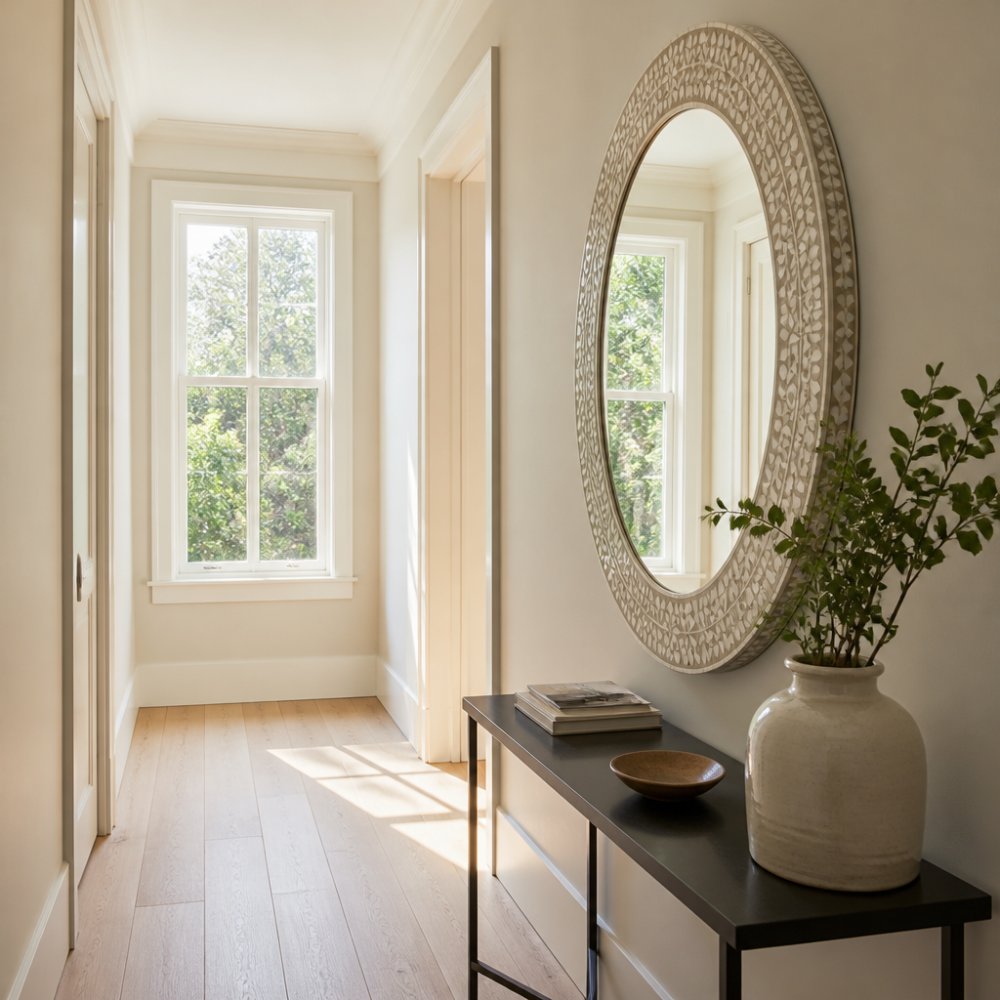
To position a mirror to reflect light, hang it on a wall that faces your main light source, at eye level, so it bounces daylight or lamplight back into the room. For practical placement and styling tips in tight entryways, see our guide on how to style bone inlay mirrors in small entryways.
Follow these steps:
- Face the light. Put the mirror opposite or at an angle to a window, never flat against the same wall.
- Hang at eye level. Centre the mirror roughly 150cm to 160cm from the floor.
- Angle slightly if needed. A small tilt can catch a light source a straight mirror misses.
- Keep the reflection clear. Avoid hanging opposite clutter that the mirror will double.
A mirror does not create light. It redistributes it. Place it where it can catch a bright patch and send it where the hallway is darkest.
Round vs Rectangular Hallway Mirror: Which Suits Your Light Source?
A round hallway mirror softens and spreads light evenly, while a rectangular hallway mirror directs and repeats it in straight lines.
How curved surfaces handle light. A round or oval frame reflects a wide field of view across a curved surface.
How flat surfaces handle light. A rectangular mirror reflects a straight, undistorted view.
Here is how the main light sources play out:
| Light Source | Best Shape | Why | Watch Out For |
|---|---|---|---|
| Diffuse window light | Round or oval | Curvature spreads the soft light evenly | Distortion of straight lines opposite |
| Single pendant or ceiling light | Round | Curved surface softens the downward pool of light | A flat rectangle can look dull under one bulb |
| Linear fitting or strong doorway light | Rectangular | Flat surface repeats the straight lines and adds structure | Clutter opposite is doubled clearly |
| Wall sconce | Oval or arched | Vertical stretch pulls the pool of light up the wall | A wide rectangle may miss the sconce's cone |
| No direct light (borrowed light only) | Round or oval | Curvature catches and spreads weak, indirect light | A flat mirror may reflect only a dark wall |
A common mistake is choosing a rectangular mirror for a hallway lit only by a single soft bulb.
A second mistake is hanging a round mirror opposite a strong linear light fitting. The curvature bends the straight line of the fitting into a curve, which can look odd in a formal hallway.
Hallway Mirror Size and Placement: Getting the Proportions Right
Hallway mirror size and placement should follow the wall, not the mirror. A frame that is too small looks lost; one that is too large overwhelms a narrow space. As a rule, leave at least 15cm of wall on each side of the frame.
Match the mirror width to the furniture below it. A mirror hung over a console should be slightly narrower than the console top. For a standalone wall, aim for a mirror that fills about two-thirds of the available height.
- Wall width under 100cm: choose a mirror 50cm to 70cm wide.
- Wall width 100cm to 150cm: choose a mirror 70cm to 90cm wide.
- Wall width over 150cm: choose a mirror 90cm or wider.
- Hang height: centre at eye level, around 150cm to 160cm from the floor.
Always measure the wall and the reflection before you drill. A mirror that reflects a blank wall adds nothing. One that reflects a bright room adds light and depth.
Matching Mirror Shape to Your Hallway's Lighting Temperature and Interior Style
Lighting temperature changes how a mirror looks. Warm light tends to suit cream and natural tones, while cool light tends to suit white and black frames. Match your mirror's finish to the light you have.
In a warm-lit hallway, a cream or natural bone frame glows. In a cool-lit space, a white or black frame reads sharper. Our Bone Inlay Moghul Arch Mirror in Floral Cream suits a warm-lit hallway, while the Bone Inlay Round Mirror in Zig Zag Black suits a cooler-lit space.


Style matters too. A modern minimalist hallway can carry a single sculptural inlay piece as its focal point. An ornate frame in an already busy space competes for attention.
Common Mistakes That Undermine a Hallway Mirror
The biggest hallway mirror mistakes are hanging too high, choosing a shape that fights the light, and letting the frame crowd the wall. Each one quietly cancels the benefit you were hoping for.
Watch out: hanging a mirror flat against the same wall as your only window. It will reflect a dull wall and never catch the light. Turn it to face the window instead.
Other traps to avoid:
- Hanging the mirror above eye level, so it reflects the ceiling.
- Choosing a frame wider than the console beneath it.
- Placing the mirror opposite a cluttered wall that it will double.
- Ignoring colour temperature and buying a cool-toned frame for a warm room.
Shop Handcrafted Hallway Mirrors for Your Space
Choosing the right mirror shape for hallway lighting comes down to three things: your wall width, your light source, and the mood you want. Get those right and the shape follows naturally.
At Mahlia Interiors, our pieces are individually handcrafted using 100% ethically sourced materials, and we offer custom inlay design so you can tailor a piece to your space.
Frequently Asked Questions
What mirror shape is best for a hallway?
There is no single best shape, but the hallway's proportions and light source should guide you. A round or oval hallway mirror softens narrow, tall spaces and bounces light from side windows without creating harsh angles. Rectangular or arched shapes suit wider hallways and add vertical height when hung above a console. Measure your wall width and note where natural light enters before deciding, then match the shape to the dominant lines of the space.
How can a mirror make a dark hallway brighter?
A mirror brightens a dark hallway by reflecting light from windows, skylights or light fittings back into the space. Position the mirror on the wall opposite or adjacent to the light source so it catches the beam rather than facing a blank wall. Larger mirrors reflect more light, and a light-coloured frame such as white bone inlay keeps the reflection warm. Avoid placing a mirror where it faces a dark corner, as it will simply double the gloom.
Are round mirrors good for narrow hallways?
Yes. A round hallway mirror works well in a narrow space because its curves break up the hard parallel lines of the walls and stop the corridor feeling like a tunnel. A 70cm round mirror, like the Bone Inlay Round Mirror in Seashell White, suits most standard hallway widths without overwhelming the wall. Hang it at eye level so it reflects the opposite wall and any light coming from doorways, which visually widens the space.
How high should a hallway mirror be hung?
Hang a hallway mirror so the centre of the glass sits at average eye level, roughly 150cm to 160cm from the floor, which lets most adults see their reflection comfortably. If the mirror hangs above a console table, leave 15cm to 20cm of clearance between the tabletop and the bottom of the frame. In a hallway with a high ceiling, raising the mirror slightly can draw the eye upward and make the space feel taller.
Ready to brighten your entryway? Get started with Mahlia Interiors and shop our new arrivals to find a handcrafted mirror that fits your space, your light, and your style.