
Sustainable Practices in Luxury Furniture Manufacturing

Last Updated: October 30, 2026
Quick Summary
Sustainable practices in luxury furniture manufacturing mean designing, sourcing and building pieces so their environmental cost stays low across their whole life. Makers document material origins, choose low-VOC finishes and certified or reclaimed timber, reduce waste, and design furniture durable enough to last for decades.
- Track each material's origin, recycled content, certification status and end-of-life route in a bill of materials.
- Pair forest certification with batch-level records and supplier audits to support a verifiable sourcing claim.
- Specify low-VOC finishes and no-added-formaldehyde boards, verified through supplier documentation.
- Measure energy, waste by weight and supplier documentation coverage against a baseline before making claims.
- Design for repair with re-tightenable joints and available replacement inlay panels to extend product life.
Table of Contents
- What Sustainable Furniture Manufacturing Means for Luxury Makers
- Environmental Impacts of Conventional Furniture Production
- Sustainable Furniture Materials: Choosing What Goes Into a Piece
- Ethical Furniture Sourcing and Traceability
- Eco-Friendly Furniture Manufacturing: Energy, Waste and Production Methods
- Durable Furniture Design and Long Product Life
- Checking Claims Before You Buy a Sustainable Luxury Piece
- Frequently Asked Questions
What Sustainable Furniture Manufacturing Means for Luxury Makers
Sustainable furniture manufacturing is the practice of designing, sourcing and building furniture so that its environmental cost is kept as low as possible across its whole life, and it is central to modern luxury furniture manufacturing. For luxury makers, this goes beyond choosing greener materials.
Much of the published guidance on this topic is aimed at mass-market furniture. Luxury makers face a different set of pressures. Their pieces are made in small runs, often by hand, and buyers expect a degree of exclusivity and detail that rules out cheap shortcuts.
The gap between a sustainable claim and a verifiable one is where many luxury brands get caught out.
Environmental Impacts of Conventional Furniture Production
Conventional furniture production consumes large volumes of timber, metals, plastics and finishing chemicals, and much of that material ends up as production waste. Offcuts, damaged stock and surplus finishes are common, and disposal of these streams has its own environmental cost.
Finishes deserve particular attention. Solvent-based coatings and some adhesives release volatile organic compounds, which affect both factory air quality and the indoor air of the finished home. Low-VOC alternatives exist, though they must be matched carefully to the piece's construction and intended use.
Forest impact is another concern. Wood sourced without certification can contribute to habitat loss and unverified harvesting. Sustainability guidance commonly points to FSC-certified or reclaimed timber as the starting point for responsible sourcing, though certification alone does not settle every question about a supply chain.
Sustainable Furniture Materials: Choosing What Goes Into a Piece
Material choice is the first lever a maker controls, and it shapes both the environmental footprint and the durability of the finished piece. Sustainable furniture materials generally fall into three groups: reclaimed or recycled inputs, renewable resources and materials with lower-impact processing. Each group carries trade-offs that a responsible maker must weigh openly, and, increasingly, document.
Reclaimed, Recycled and Renewable Inputs
Reclaimed timber diverts material from landfill and avoids new harvesting, which is why it features in almost every sustainability guide for furniture. Recycled metals and glass add further options, and renewable resources such as bamboo grow quickly. But the benefit of any input depends on processing, not on the raw material alone.
For a luxury maker working with natural inlay materials, the question is less about replacing the core material and more about ensuring that each input can be traced to a responsible origin. A reclaimed timber carcass paired with an inlay whose source is unknown is only partly sustainable. A practical rule is to treat every material, including adhesives, finishes and inlay, as a line item in a bill of materials that carries an origin and a verification status.
Certification and Responsible Wood Sourcing
Responsible wood sourcing usually starts with forest certification. The Forest Stewardship Council (FSC) and the Programme for the Endorsement of Forest Certification (PEFC) are the two schemes most commonly referenced by Australian suppliers and specifiers. Chain-of-custody certification is what allows a maker to link a finished piece back to certified forest inputs; without it, a claim of 'FSC-certified timber' is difficult to substantiate at product level. Reclaimed timber sits outside these schemes but can be documented through supplier declarations and batch records.
Certification is not a complete answer. It confirms that a forest is managed to a standard, not that a specific board came from that forest. Makers should therefore pair certification with batch-level records and, where possible, supplier audits. This is the practical difference between a sourcing policy and a verifiable claim.
Low-VOC Finishes and Safer Adhesives
Finishes and adhesives are often overlooked in sustainability discussions, yet they affect both the factory environment and the home. Water-based adhesives and low-VOC finishes reduce emissions during curing and lower the risk of indoor air pollution once the piece is in use. The trade-off is that some low-VOC products demand more careful application and may not offer the same long-term surface protection as solvent-based coatings, so makers should test them against the demands of each piece. Formaldehyde-based binders in composite panels are a particular concern; specifying no-added-formaldehyde or low-emission boards is a concrete step that can be verified through supplier documentation.
A Lifecycle Lens on Material Choice
Comparing materials honestly requires a cradle-to-grave view rather than a single-attribute claim. Embodied carbon, the emissions associated with extracting, processing and transporting a material, varies widely between options, and end-of-life pathways matter too. A timber component that can be reused or composted has a different end-of-life profile from a composite panel that cannot be separated. Most practitioners find that a simple material inventory, listing each input with its origin, recycled content, certification status and likely end-of-life route, is enough to expose the biggest trade-offs without a full lifecycle assessment. Where a formal assessment is warranted, the ISO 14040 and ISO 14044 standards provide the recognised framework for conducting one.
Ethical Furniture Sourcing and Traceability
Ethical sourcing is central to any credible claim of sustainable luxury. For a maker using bone and mother of pearl, that means knowing where the material comes from, how it was harvested and whether the supply chain can be documented.
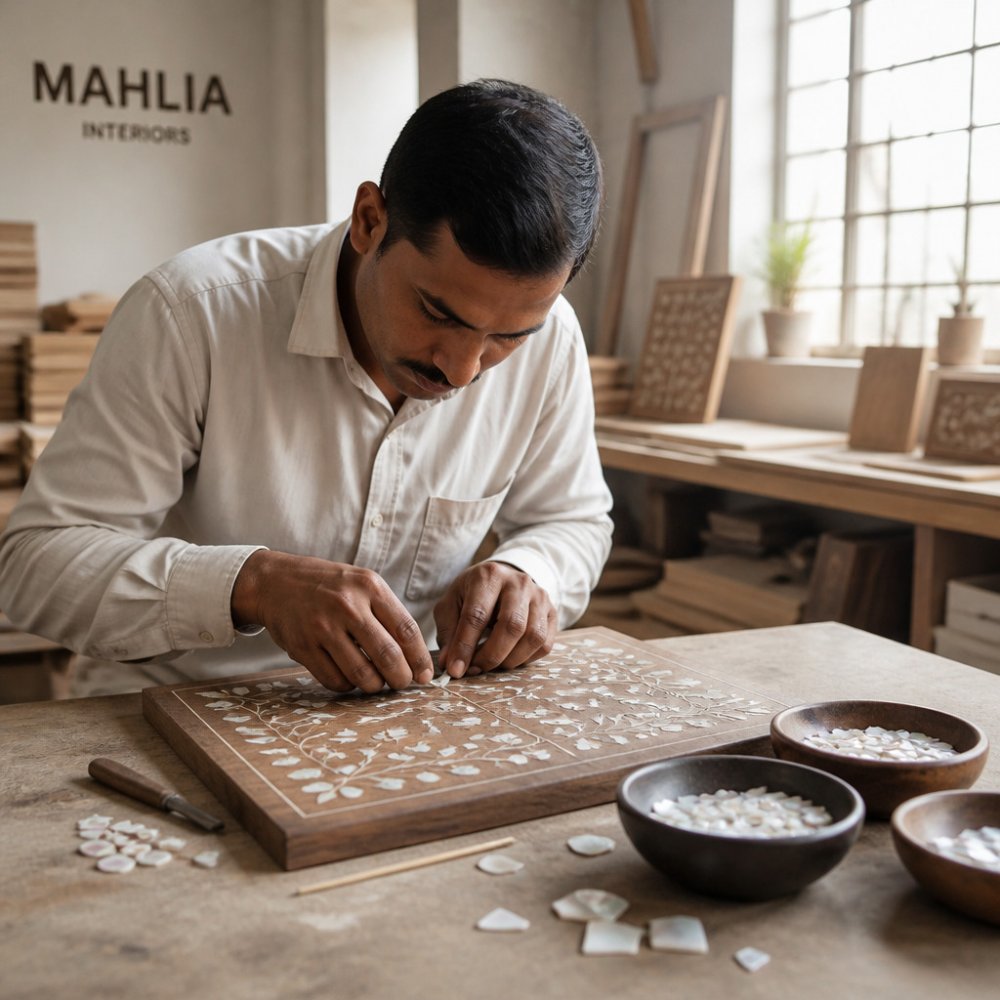
Traceability works best when it is built into production from the start. Recording the origin of each material batch, keeping supplier documentation and linking that record to the finished piece allows a maker to answer a buyer's question with evidence.
For more on how to assess these claims before buying, see our [page:1] guide, and for the origins of mother of pearl specifically, our [page:2] article explains the sourcing process in more detail.
Eco-Friendly Furniture Manufacturing: Energy, Waste and Production Methods
Production methods determine how much energy and waste a piece carries before it reaches the customer. Energy-intensive processes such as kiln drying, machining and finishing can be made more efficient through better scheduling, improved insulation and, where feasible, renewable power.
Waste reduction is often the quickest win. Precise cutting, careful nesting of templates and reuse of offcuts for smaller components can cut material loss substantially. Makers should track waste by weight so that improvements can be measured rather than assumed. Solvent recovery and proper disposal of finishing chemicals are equally important; pouring them down drains or into general waste creates pollution that undermines any other sustainability effort.
Bone Inlay Drinks Cabinet wtih Antique Brass Legs : Pinstripe : Charcoal →
A Staged Implementation Roadmap
Most published guidance stops at listing good practices. A more useful approach for a luxury workshop is a staged plan with indicators that can be tracked over time.
Stage 1, Baseline and measure (first quarter). Record energy consumption per unit produced, waste generated by weight and by stream, recycled content in the bill of materials, and the proportion of suppliers who can provide chain-of-custody documentation.
Stage 2, Quick wins (months three to six). Improve cutting and nesting to reduce offcuts, switch to low-VOC finishes and adhesives where performance allows, segregate waste streams, and schedule energy-intensive processes to avoid peak demand.
Stage 3, Supplier engagement (months six to twelve). Set a target for the share of timber that is certified or reclaimed, request batch-level documentation from inlay and adhesive suppliers, and begin auditing the highest-risk inputs.
Stage 4, Capital and design changes (year two onward). Consider renewable electricity, more efficient drying or extraction equipment, and design changes that reduce material use or improve repairability. These decisions should be justified against the baseline data gathered in Stage 1.
Indicators Worth Tracking
A small set of indicators keeps the programme honest: energy per unit produced, waste diversion rate (the share of waste diverted from landfill), recycled content as a percentage of material input, emissions per unit where data allows, and supplier documentation coverage. Tracking these quarterly is more useful than an annual sustainability statement, because it shows whether practices are actually changing.
For a maker, the value of this discipline is that it turns broad sustainability language into a record that can be shown to a buyer, a supplier or an auditor, and it makes the next improvement obvious rather than aspirational.
Durable Furniture Design and Long Product Life
The most sustainable piece of furniture is often the one that is never replaced. Durability, repairability and timeless design all extend product life, and in luxury furniture they matter as much as material choice. A well-built piece that lasts decades carries a far lower environmental cost per year of use than a cheaper item that is discarded within a few seasons.
Design for repair is a practical principle here. Using joints that can be re-tightened, keeping replacement inlay panels available and choosing neutral finishes that do not date all help a piece stay in use. Custom pieces are made to order with a lead time of 6-8 weeks from deposit payment.
Lead times and care steps for keeping a luxury piece in service are summarised below.
| Item | Value | Note |
|---|---|---|
| Custom lead time | 6-8 weeks | From deposit payment |
| Humidity | Protect from | Reduces wear on pieces |
| Joints | Re-tightenable | Supports repair over time |
Checking Claims Before You Buy a Sustainable Luxury Piece
Buyers are right to be sceptical of sustainability claims, and the market contains plenty of vague language.
Look for the reasoning behind a claim as well as the claim itself.
Ask also about the process for custom pieces, including timelines and what happens if a finished piece does not match the agreed design.
Frequently Asked Questions
What makes luxury furniture sustainable? Luxury furniture is sustainable when its materials are responsibly sourced, its production minimises waste and emissions, and its design allows a long working life.
How long does a custom Mahlia Interiors piece take to arrive? Custom lead times are 6-8 weeks from deposit payment. This timeline allows each handcrafted inlay piece to be made with care.
Frequently Asked Questions
What makes luxury furniture sustainable?
Sustainable luxury furniture combines responsibly sourced materials, low-impact finishes, energy-conscious production and a design built to last for decades. Durability matters as much as materials, because a piece that is repaired and kept in use avoids the environmental cost of replacement. Buyers can look for clear information on where materials come from, how pieces are made and whether the maker can explain its process in plain terms. Claims that cannot be explained or traced deserve closer questions before purchase.
What materials are used in sustainable furniture manufacturing?
Common choices include reclaimed or recycled timber, FSC-certified wood, renewable plant-based materials, and natural materials such as shell or bone used for inlay work. Finishes with low volatile organic compound content and water-based adhesives reduce indoor air pollution during and after manufacture. The best option depends on the piece, its intended use and how well the supply chain can be verified. Ask the maker which materials are used in each component rather than accepting a general sustainability label.
How can you tell whether furniture is ethically made?
Start by asking where the materials come from, who makes the piece and under what conditions. Ethical sourcing is easier to trust when a maker can name its suppliers, describe its artisan partnerships and explain how materials are traced. Documentation such as forest certification or supplier records is useful when available. Where documentation is limited, the clarity and consistency of the maker's answers is itself a signal worth weighing.
What should buyers ask a furniture maker about sourcing and production?
Useful questions include which materials go into each piece, where each material is sourced, how finishes and adhesives are chosen, and how production waste is handled. Ask how long the piece is designed to last and whether it can be repaired or refinished. You can also ask about lead times and how custom orders are produced, since made-to-order pieces are often built to specification rather than stock. Honest makers will answer these questions directly.