
Why Is Artisan Furniture More Expensive? A 2026 Guide

Table of Contents
- What Your Money Actually Pays For in Artisan Furniture
- Material Quality and Raw Material Costs
- Craftsmanship, Skilled Labour and Production Time
- Design Complexity and Custom Design Work
- Handcrafted Furniture vs Mass-Produced Furniture: The Real Trade-Offs
- How to Spot Authentic Handcrafted Inlay Furniture
- Ethical Sourcing of Bone and Mother-of-Pearl Inlay
- Is Artisan Furniture Worth It? A Lifetime-Cost View
- Frequently Asked Questions
Last Updated: October 17, 2026
What Your Money Actually Pays For in Artisan Furniture
Artisan furniture costs more because you are paying for materials, time, skill and design, not just a finished object. At Mahlia Interiors, we break every piece down into those four parts. It is the clearest way to see why a handcrafted chest and a flat-pack unit can look alike in a photo yet sit worlds apart in price.
A mass-produced unit hides its costs. A handcrafted piece shows them.
Here is the breakdown we walk customers through:
- Raw materials: solid timber and inlay materials, not veneer over particleboard
- Labour hours: one maker, one piece, start to finish
- Design work: patterns drawn, colours matched, proportions set
- Finishing: sanding, sealing and hand-polishing done in stages
Most guides skip this part. They say "handmade costs more" and move on. That tells you nothing about value.
Below, we show exactly where the extra money goes, how to judge whether a piece is genuinely handcrafted, and when the premium is worth it.
Material Quality and Raw Material Costs
Solid timber costs more than engineered board, and the gap widens with every step up in grade. But the raw board price is only part of the material cost. A maker choosing timber also pays for the wastage from cutting around defects, the drying time before it can be worked, and the yield loss when a board does not suit the piece.
Here is how material costs break down in practice:
- Board selection: higher grades with fewer knots and consistent grain cost more per cubic metre than utility grades.
- Wastage: cutting around defects and matching grain across drawer fronts can waste 20-30% of a board. That waste is priced into the piece.
- Drying and stabilisation: timber must be dried and rested before working, which ties up stock and adds handling cost.
- Inlay materials: bone and mother-of-pearl are set by hand, piece by piece, so the material cost includes the inlay itself plus the labour to prepare and place it.
Cheaper furniture swaps solid timber for veneer over particleboard. It looks fine on day one. It rarely survives a decade of real use. The material saving is real, but it is a saving on the purchase price, not on the lifetime cost.
When you compare quotes, ask for the species, the grade, and whether the frame and drawer fronts are solid or veneered. A maker who can answer clearly is usually working with materials worth paying for.
Craftsmanship, Skilled Labour and Production Time
Skilled labour is the single biggest cost in handcrafted furniture, and it is the hardest to fake. A mass-produced piece moves down a line in minutes. A handcrafted piece stays with one maker through cutting, joining, inlay work and finishing.
Time is the tell. Our custom pieces run on a lead time of 6-8 weeks from deposit payment, because the work is done to order rather than pulled from a warehouse.
That wait is not a flaw. It is the production process showing its seams.
What most guides miss is that labour cost scales with complexity, not size. A small chest with dense inlay can take longer than a large plain table. The hours follow the detail.
Design Complexity and Custom Design Work
Custom design adds cost before a single cut is made. Someone has to draw the pattern, choose the colour, set the proportions and confirm the details with you. That design work is real labour, and it happens once per piece.
Our Bone Inlay Dining Table with Pedestal Base shows how far customisation can go. It can be made in any colour and any inlay pattern. That flexibility is the point, and it is also why it costs more than a fixed design.

Simple, repeatable designs cost less. Intricate patterns, curved forms and bespoke sizing cost more. Neither is better. They serve different rooms and different budgets.
Handcrafted Furniture vs Mass-Produced Furniture: The Real Trade-Offs
The honest comparison comes down to upfront price against lifespan, repairability, and replacement frequency. Mass-produced furniture wins on purchase price. Handcrafted furniture wins on durability and longevity. But the real trade-off is clearer when you look at cost per year of use.
Here is how the two stack up:
Bone Inlay 3 Drawer Chest : Floral : Grey →
| Factor | Handcrafted Furniture | Mass-Produced Furniture |
|---|---|---|
| Upfront cost | Higher | Lower |
| Materials | Solid timber, real inlay | Veneer, engineered board |
| Production | Made to order, one maker | Assembly line, high volume |
| Lifespan | Decades with care | Often replaced within years |
| Design | Customisable | Fixed ranges |
| Repairs | Can be repaired and refinished | Often replaced, not fixed |
| Cost per year of use | Lower over time | Higher if replaced repeatedly |
A practical way to compare is to divide the purchase price by the expected years of use. A mass-produced piece that costs less but is replaced every five years can cost more per year than a handcrafted piece kept for twenty. The table above is a starting point, not a verdict.
Neither column is wrong. A first rental flat may not need an heirloom chest. A home you plan to keep for twenty years is a different calculation. The premium is justified when you value repairability, customisation, and the ability to refinish rather than replace.
If you are furnishing a short-term rental or a space you will leave soon, a smaller, flexible piece may make more sense. We would rather tell you that than sell you a statement chest that does not fit your life.
How to Spot Authentic Handcrafted Inlay Furniture
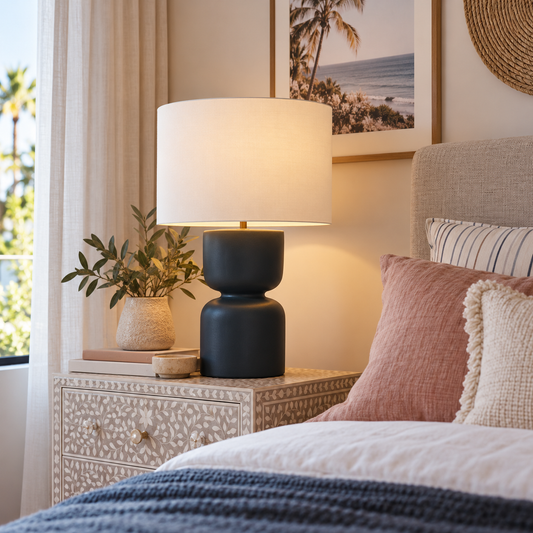
Authentic handcrafted inlay furniture shows small, human variations in the pattern, the surface and the finish. Machine-printed or decal "inlay" is uniform to the millimetre. Real hand-set inlay never is.
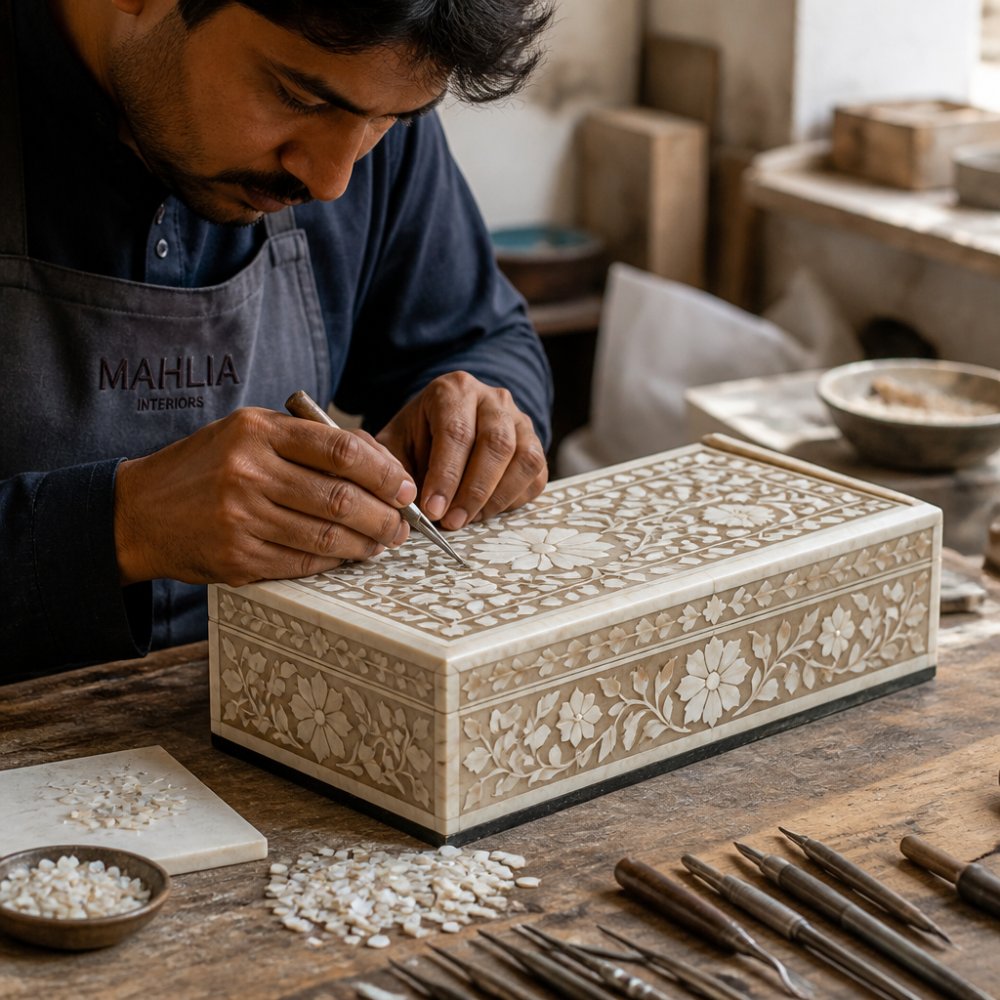
Use this checklist when you inspect a piece:
- Look for slight differences in pattern spacing and colour
- Check that inlay sits flush, not printed flat on the surface
- Feel the edges: hand-finished edges are smooth but not identical
- Ask whether the pattern can be customised (printed patterns cannot)
- Look at the back and inside, where shortcuts show first
- Ask for the material and colour options in writing
If every piece in a range looks pixel-identical, it is not hand-set inlay.
Ethical Sourcing of Bone and Mother-of-Pearl Inlay
Ethical sourcing of bone and mother-of-pearl inlay means knowing where the materials come from and how the makers are treated. It is a fair question to ask any furniture retailer, and the answer should be clear rather than vague.
At Mahlia Interiors, our pieces use 100% ethically sourced materials, and we support the artisan communities who make them. That commitment is part of what you pay for.
Buyers should ask three things:
- Where do the bone and shell materials come from?
- Who makes the piece, and how are they paid?
- Can the retailer explain the sourcing in plain terms?
Vague answers are a warning sign. Clear ones are worth the premium.
Is Artisan Furniture Worth It? A Lifetime-Cost View
Artisan furniture is worth it when you plan to keep a piece for years and want something no one else owns. The lifetime-cost view makes this concrete: one well-made chest that lasts decades usually costs less per year than three cheap replacements.
[Take our Bone Inlay 3 Drawer Chest : Floral : Grey](https://mahliainteriors.com.au/products/bone-inlay-floral-3-drawer-chest-grey). It is made to order, handcrafted, and built with three drawers on premium Hettich metal sliders. That is a piece you repair and refinish, not replace.

The premium is not worth it in every case. If you are renting short term or furnishing a space you will leave soon, a smaller, flexible piece makes more sense. We would rather tell you that than sell you a statement chest that does not fit your life.
Frequently Asked Questions
What makes artisan furniture more expensive than mass-produced furniture?
The price gap comes down to how the piece is made. Artisan furniture uses solid timber and materials like bone or mother-of-pearl, built by hand over weeks rather than minutes on a production line. Skilled labour, intricate inlay work, design time and small production volumes all add cost. A mass-produced chest might be assembled from veneered particleboard in a factory; a handcrafted bone inlay chest like the Floral Grey 3 Drawer Chest at $3,490 involves hundreds of individually cut pieces set by hand, which is why the purchase price sits higher.
How can you tell if handcrafted inlay furniture is authentic?
Look closely at the pattern. Genuine handcrafted inlay shows slight variations in colour, pattern and finish because each piece is set by hand, and no two are identical. Check the edges of the inlay for individual pieces rather than a printed or laser-cut sheet. Ask the maker about their process, materials and lead times; authentic pieces are usually made to order with a lead time of weeks, not shipped from stock the same day. Mahlia Interiors notes on every listing that variations are inherent to the artisanal process.
Does handmade furniture last longer?
It often does, because the construction and materials differ. Solid timber frames, metal drawer sliders such as the Hettich runners used in Mahlia Interiors chests, and hand-finished surfaces can be repaired and refinished over time. Mass-produced pieces built from particleboard and veneer are harder to repair once the surface lifts or the frame loosens. Longevity depends on care and climate, but a well-made artisan piece is designed to be maintained rather than replaced, which changes the lifetime cost calculation.
How do you check whether inlay materials are ethically sourced?
Ask the maker directly for documentation and a clear explanation of where bone and mother-of-pearl come from and how artisan communities are involved. Reputable sellers will answer without hesitation and can describe their sourcing process. Look for statements about ethical sourcing on product listings and ask what certifications or records they hold. If a seller cannot explain the origin of their materials or brushes off the question, treat that as a warning sign. Mahlia Interiors states that its materials are 100% ethically sourced and supports artisan communities.
Choosing furniture that lasts is a decision about materials, makers and time, and it is easy to get wrong without a clear guide. At Mahlia Interiors, we handcraft every piece to order, using 100% ethically sourced materials and supporting the artisan communities behind the work. You can customise colour, pattern and size to suit your space, with a lead time of 6-8 weeks from deposit payment. Shop our new arrivals and find a piece built to stay with you.