
Ethical Sourcing of Mother of Pearl: 2026 Guide

Table of Contents
- What Ethical Sourcing of Mother of Pearl Actually Means
- Ethical Pearl Farming and Responsible Shell Harvesting
- Mother of Pearl Origin and Traceability: Following the Chain of Custody
- Real Versus Imitation Mother of Pearl: What You Are Actually Buying
- Worker Welfare, Byproduct Use and Shell Processing
- Ethical Sourcing Questions for Furniture Buyers
- Conclusion: Choosing Inlay Pieces You Can Stand Behind
- Frequently Asked Questions
Last Updated: October 12, 2026
What Ethical Sourcing of Mother of Pearl Actually Means
Ethical sourcing of mother of pearl means knowing where the shell came from, how it was harvested, and who handled it. At Mahlia Interiors, we treat it as the difference between a piece you love and a piece you can defend.

Mother of pearl is the iridescent inner lining of certain mollusc shells, formed from nacre, the same material that coats the outside of a pearl. The shell is a byproduct of pearl farming or of food harvesting, not a gemstone cut from the earth.
That distinction matters. Mined gemstones require digging, blasting and heavy water use. Shell grows in the ocean, on reefs, in farms and in riverbeds.
Ethical sourcing asks three plain questions: was the shell taken legally, was the marine environment left healthy, and were the people who worked it paid fairly? A fourth sits underneath all of them. Can you prove any of it?
Here is what most guides get wrong. They treat "sustainable" as a feeling. It is not. It is paperwork, species names and harvest records.
Ethical Pearl Farming and Responsible Shell Harvesting
The strongest ethical supply chains start with farming, not wild collection. Pearl cultivation gives communities a reason to keep their water clean, because dirty water kills the crop.
A typical farm cycle runs like this:
- Hatchery breeds or collects juvenile shellfish
- Grow-out in clean, monitored water
- Nucleation, where a small bead and a piece of mantle tissue are inserted
- Months to years of care while nacre coats the nucleus
- Harvest of the pearl, with the shell retained
The shell is the part most buyers forget. After the pearl is removed, the nacre lining still has value. That is where mother of pearl inlay comes from.
Responsible harvesting means taking shell at a rate the population can replace, and leaving breeding stock alone. The Australian Government's fisheries and aquaculture guidance sets out how Commonwealth fisheries are managed, which is a useful benchmark for what regulated harvest looks like. In practice, a licensed operator works to a harvest strategy that sets a total allowable catch, monitors stock health, and can be closed when numbers fall. That is the difference between a fishery and a free-for-all.
Wild-Harvested Versus Farmed Shell: Species and Harvest Impacts
Farmed shell is the safer ethical bet. The species is known, the volume is controlled, and the operator has a licence to lose if they cut corners. A farmed pearl oyster is bred, grown and harvested on a known cycle, so the shell can be traced back to a specific lease and batch.
Wild harvest is harder to verify. It can be legal and well managed, or it can strip a reef. The species matters too. Pearl oysters, abalone and freshwater mussels all produce nacre, and each has a different conservation status depending on where it lives. Some are abundant; others are protected, listed, or subject to strict quota. A supplier who cannot name the species cannot know which rules apply.
Three practical distinctions separate the two paths:
- Farmed shell is a predictable byproduct of pearl or food production. The species is usually a known pearl oyster or edible mussel, the harvest is planned, and the shell is a secondary revenue stream rather than the main event.
- Wild-collected shell is taken from a natural population. It may be legal under a permit or quota, but the impact depends on the species, the method, and whether breeding stock is left behind. Diving, dredging and shore collection all have different footprints.
- Protected species sit outside both categories. If a species is listed under conservation law or an international trade convention, commercial harvest and export may be restricted or banned regardless of how it was taken.
Ask which species. A supplier who cannot name it is not tracking it. Then ask whether the shell came from a farm, a licensed fishery, or an unregulated wild source, and whether the species is subject to any protection. Those two answers tell you more about ethics than any sustainability slogan.
Mother of Pearl Origin and Traceability: Following the Chain of Custody
Traceability is the paperwork trail from reef to finished piece. Without it, every ethical claim is just a sentence.
A real chain of custody records:
- The farm or fishery and its licence
- The species and harvest date
- The processor and export documentation
- The workshop that cut and set the shell
- The finished piece and its batch
The Convention on International Trade in Endangered Species controls cross-border trade in listed species, and some nacre-producing shellfish fall under it. If a supplier ships internationally, they should know whether their species is listed.
This is where most claims fall apart. A retailer can say "ethically sourced" honestly and still have no idea which farm the shell came from.
Real Versus Imitation Mother of Pearl: What You Are Actually Buying
Genuine mother of pearl is shell. Imitation is plastic, resin, or a printed film over a base material.
Mother of Pearl Rectangular Tray : Floral : White →
The difference shows up fast:
- Depth: real nacre shifts colour as you move. Plastic looks flat.
- Weight: shell is dense and cool to the touch.
- Edges: hand-cut inlay has slight variation. Stamped imitation is uniform.
- Grain: real shell shows natural lines and tiny irregularities.
Ethical sourcing only applies to the real thing. You cannot trace a sheet of polyester film to a reef, and no one should pretend otherwise.
Worker Welfare, Byproduct Use and Shell Processing
Cutting and setting inlay is skilled, hand-heavy work. A single floral panel on a tray can take hours of precise cutting, and the people doing it deserve fair pay and safe conditions.
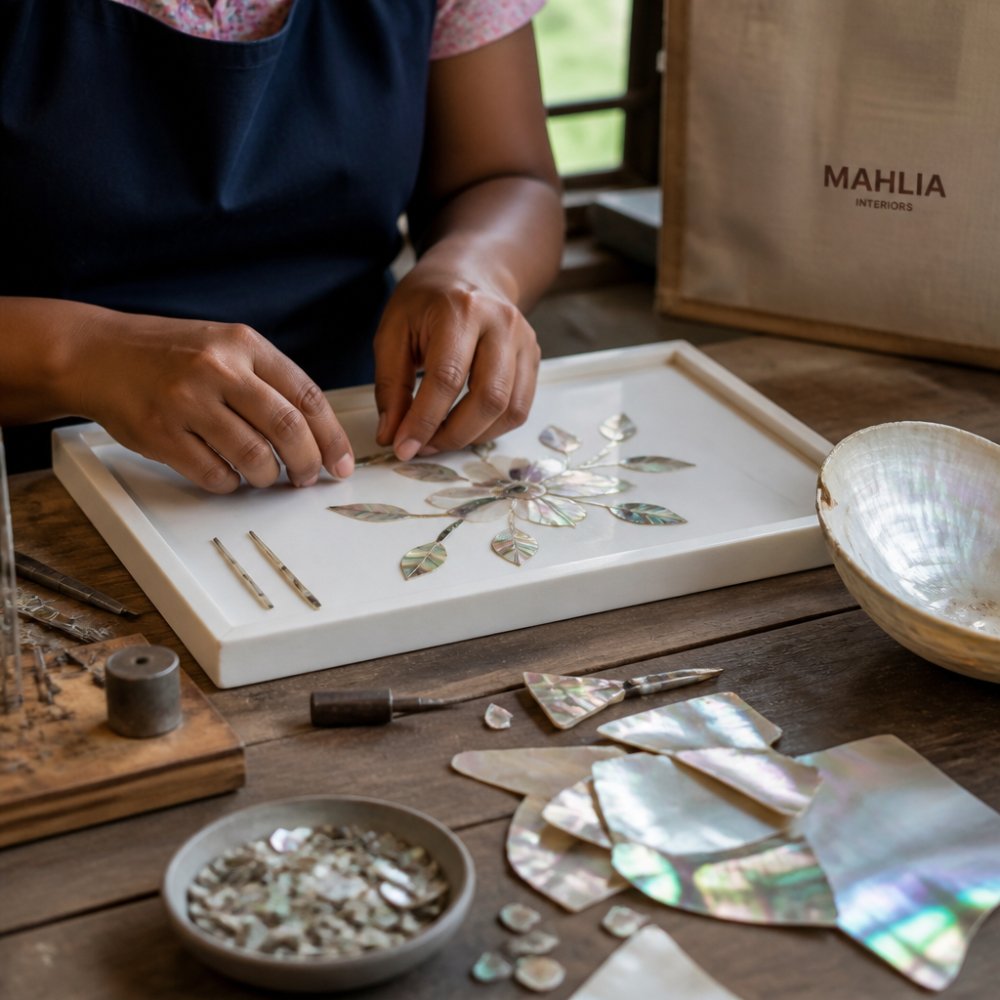
Most guides stop at the environment. That leaves out half the story. Ethical sourcing also asks who cut the shell, how they were paid, and what happened to the waste.
Worker welfare. Inlay work is repetitive and precise. The risks are familiar: fine shell dust, sharp edges, long hours at a bench, and piece-rate pay that rewards speed over safety. A responsible workshop provides dust extraction, eye protection, ergonomic seating, and a wage that does not depend on cutting corners. The Fair Work Ombudsman sets the wage and condition standards that apply to work performed here. For overseas workshops, the honest question is whether the maker can show you their pay and safety practices, not whether they can describe them in a brochure.
Byproduct use. Mother of pearl is almost always a byproduct, not a primary harvest. Pearl oysters are farmed for pearls; abalone and mussels are harvested for food. The shell is what remains. That is good news ethically, because it means the material is not driving the harvest. But it also means the supply chain is only as traceable as the primary product. If the pearl or food supply chain is opaque, the shell inherits that opacity.
Processing and waste. Turning a curved shell into flat inlay involves cutting, grinding, polishing and finishing. Each step produces offcuts, dust and slurry. Good supply chains waste less:
- Large offcuts become smaller inlay pieces or buttons
- Shell dust can be used in composite work or as a filler
- Slurry is captured rather than washed into waterways
- Rejected pieces are re-cut rather than discarded
Nothing useful should go to landfill. A workshop that cannot say what happens to its offcuts is not managing its waste.
What to ask. Which workshop cut and set the shell? How are those workers paid and protected? Is the shell a byproduct of pearl or food production? What happens to offcuts and shell dust? The answers are short if the supplier knows them, and vague if they do not.
Ethical Sourcing Questions for Furniture Buyers
Bring these to any seller. The answers tell you more than any marketing page.
- Which species is the shell, and where was it harvested?
- Is the shell farmed or wild-collected?
- Can you show chain-of-custody documents?
- Which workshop cut and set the inlay?
- How are those workers paid and protected?
- What happens to offcuts and shell dust?
- Is the shell a byproduct of pearl or food production?
At Mahlia Interiors, every piece is made with 100% ethically sourced materials and individually handcrafted by skilled artisans. Our Mother of Pearl Rectangular Tray : Floral : White is a good place to start if you want to see the standard of inlay up close. Smaller pieces like our Mother of Pearl Inlay Round Tray : Floral : Grey suit renters who want something beautiful without a permanent commitment.

| Question | Weak Answer | Strong Answer |
|---|---|---|
| Species | "Natural shell" | Named species, e.g. pearl oyster |
| Origin | "Sourced overseas" | Country, farm or fishery named |
| Harvest type | "Sustainable" | Farmed or wild, with licence |
| Documentation | "We trust our supplier" | Chain-of-custody records shown |
| Workers | "Handmade" | Named workshop, stated pay practice |
| Waste | Not addressed | Offcuts reused, dust recovered |
Conclusion: Choosing Inlay Pieces You Can Stand Behind
The hard part is not finding beautiful inlay. It is finding inlay you can trace. Most sellers cannot name the species, let alone the farm.
We built Mahlia Interiors around that gap. Every piece uses 100% ethically sourced materials, is individually handcrafted, and supports the artisan communities who make it.
Shop our new arrivals and choose something you can stand behind.
Frequently Asked Questions
How can you tell whether mother of pearl is ethically sourced?
Ask for the shell species, the country of origin, and documentation that follows the shell from harvest to finished piece. A seller who can name the farm or fishery, describe the harvest method, and show chain-of-custody paperwork is far more credible than one who simply says 'ethically sourced'. Look for consistent answers across email, product listings and invoices, and be wary of vague claims that cannot be backed by any paperwork.
What is a real mother of pearl?
Real mother of pearl is the nacre lining the inside of certain shellfish shells, including pearl oysters and abalone. It is the same iridescent material a pearl is made from, just laid down as a flat inner layer rather than a rounded gem. Genuine shell has depth and colour shift that moves as you tilt it, plus subtle natural variation between pieces. Plastic or foil imitations tend to look uniform and flat under the same light.
Is mother of pearl sustainable compared with mined gemstones?
Shell grows on living animals that filter water, so farmed pearl shell is a renewable material when the farm is managed well. Mined gemstones, by contrast, are extracted from a finite deposit and can involve significant habitat disturbance and soil erosion. The sustainability of mother of pearl still depends on how the shell is harvested, whether species are legally protected, and whether the farm protects water quality and local marine biodiversity.
What should you ask a seller about mother of pearl sourcing?
Ask four things: which species the shell comes from, where it was harvested, whether it was farmed or wild-collected, and what documentation accompanies it. Then ask how the shell is processed, who does the inlay work, and what happens to leftover shell. A supplier working with artisan communities should be able to answer all of these without hesitation, and should be comfortable sharing paperwork rather than just repeating a marketing line.